
How To Plan A Fence Installation Before The Holidays
The holiday season in Central Florida brings visiting family, backyard parties, and a lot of extra foot traffic through the yard, which is exactly when a missing or failing fence becomes obvious. A fence project looks simple from the outside, but the calendar behind it moves slower than most homeowners expect, because permit review, HOA approval, material availability, and concrete cure time all stack on top of one another. Starting in early fall gives you room to absorb a delay or two; starting in mid November means you are gambling on everything going right the first time. Fall is also the best building window of the year around Winter Garden, since humidity drops, the daily afternoon storms taper off, and the ground stays workable instead of turning into saturated sand. Contractors know this, so schedules fill faster in October and November than they do in July. The homeowners who get their fence finished before Thanksgiving are almost always the ones who started asking questions in September. This guide walks through the planning steps that keep a fence installation on schedule, on budget, and standing before your first guest pulls into the driveway.
What to Plan Before a Holiday Fence Installation
Good planning happens before anyone touches a post hole digger, and it usually decides how smooth the rest of the project goes. The three things that derail residential fence projects most often are unclear property lines, unrealistic timelines, and material choices that do not match Florida conditions. Each one is easy to solve early and expensive to solve late, especially once posts are set in concrete. Homeowners who map out the schedule, confirm the boundary, and pick the right material tend to get a clean install with no surprises. Homeowners who skip those steps often end up rescheduling, paying for a survey mid project, or replacing a fence that warped within two summers. If you want the work completed before the holidays, treat the planning phase as part of the build rather than something optional that happens beforehand.
Building a Fence Installation Timeline Before the Holidays
A realistic fence installation timeline in Central Florida runs longer than the actual build, and understanding that gap is the difference between a finished fence and an unfinished one on Thanksgiving morning. The physical installation of an average residential yard, somewhere between 150 and 300 linear feet, usually takes one to three working days once a crew is on site. Everything ahead of that is where the calendar disappears. A site visit and measurement takes a few days to schedule, quoting and material selection takes another few days, permit submittal and review commonly runs one to three weeks depending on the municipality, and HOA architectural review frequently carries a written response window of thirty to forty five days. Utility locates require two full business days of notice under Florida law before any digging begins, and holidays push that window out further. Add all of it together and a project quoted in early October is realistically finished in early to mid November, which is comfortable. That same project quoted on November first is a race.
Material lead time is the variable most homeowners underestimate, because they assume every fence style sits in a warehouse ready to load. Standard six foot pressure treated pine pickets and galvanized chain link are usually stocked and move quickly. Vinyl in a specific color, ornamental aluminum in a particular picket style or height, and custom gate widths often have to be ordered, and those orders can add one to three weeks by themselves. Gate hardware for wide drive gates, including heavy duty hinges, cane bolts, and drop rods, sometimes ships separately from the panels. Supply chains also tighten late in the year as manufacturers shorten production schedules around holiday closures. Picking your material during the quote stage rather than after approval keeps the order moving in parallel with permitting instead of after it. That single decision often saves two full weeks.
Weather still matters even in a mild Florida fall, and a good timeline leaves margin for it. Post holes cannot be set properly in standing water, and a heavy rain day will push a crew back at least one working day. Concrete needs time to set before panels or rails carry any real load, and while most mixes reach enough strength to continue work within twenty four to forty eight hours, full cure takes considerably longer. Reputable companies build a buffer day or two into the schedule for exactly this reason. Cold fronts moving through in late November can also slow concrete set times slightly, though rarely enough to stop work in this part of the state. When you are ready to lock in a date, click here for our fence installation service and get on the calendar while fall slots are still open. The earlier the site visit happens, the more control you have over the finish date.
Property Lines and Survey Prep for a Fence Installation
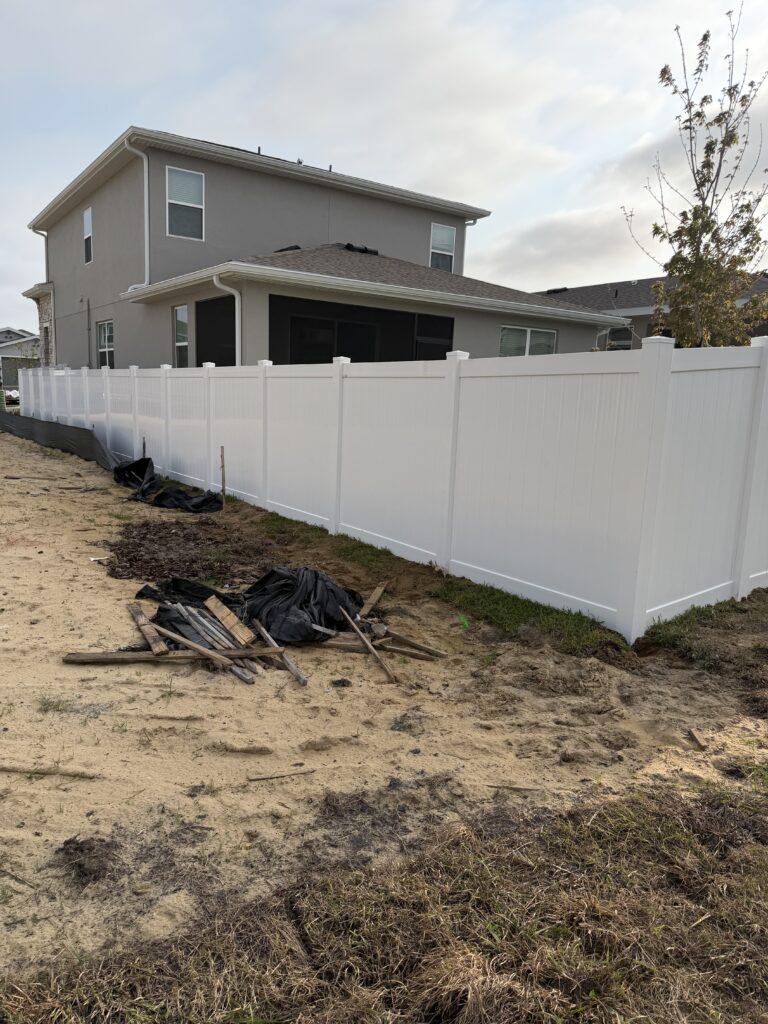
Knowing exactly where your property line sits is the single most important piece of information in any fence installation, and assuming you know is how neighbor disputes start. Many Central Florida subdivisions have irregular lot shapes, easements running along rear and side boundaries, and utility corridors that are not visible from the surface. A recorded survey shows all of it, including the boundary corners, easement widths, and any recorded setbacks that limit where a fence can legally sit. Most homeowners received a survey at closing, and that document is often still valid for fence planning if no boundary changes have occurred since. If you cannot find it, your title company or county property appraiser records are usually the fastest place to look. A licensed surveyor can also stake the corners for a few hundred dollars, which is far cheaper than moving a finished fence.
Building a fence even a few inches over the line creates real legal exposure, and it does not go away with time. A neighbor can demand removal, and in a dispute the surveyed boundary controls regardless of what the old fence did or where a hedge grew. The common and safer practice is to install slightly inside your own line, giving your crew room to work and leaving no question about ownership. That setback also gives you access to maintain both sides of the fence without stepping onto adjacent property. Easements deserve equal attention, because a drainage or utility easement may allow a fence but usually comes with the understanding that a utility company can remove sections without compensating you. Some municipalities prohibit permanent structures in easements entirely. Reviewing this before installation protects the investment.
Talking to your neighbors before work begins is practical, not just polite, and it prevents most of the friction that shows up later. Let them know the planned start date, the fence style and height, and which side the finished face will point toward. Many Central Florida HOA documents and some local codes require the finished side, meaning the side without visible rails and posts, to face outward toward the neighbor or the street. If a shared boundary fence is failing and both households benefit from replacement, some neighbors are willing to split the cost, though any agreement of that kind should be written down. It is also worth confirming that irrigation lines, invisible pet fence wire, and landscape lighting near the boundary get marked before digging. A ten minute conversation now avoids a much harder one in December.
Choosing Fence Installation Materials Built for Florida Weather
Florida punishes fence materials in ways that colder climates do not, and material selection should be driven by that reality rather than by the lowest number on a quote. Constant humidity, intense ultraviolet exposure, sandy soil, heavy summer rainfall, and hurricane season all shorten the life of anything installed carelessly. Pressure treated southern yellow pine remains the most popular privacy option because it is affordable and readily available, and quality treated lumber resists rot and insects reasonably well when installed correctly. Wood does move, though; boards cup, twist, and gray as they dry and cycle through wet and dry seasons. Sealing or staining a wood fence within the first year and repeating every two to three years extends its life substantially. Homeowners who want wood should budget for that maintenance from the beginning rather than being surprised by it later.
Vinyl and ornamental aluminum both handle the Florida climate very well, and they solve different problems. Vinyl privacy fence does not rot, will not host termites, and never needs painting, though quality varies widely between manufacturers. Look for thicker wall extrusions, ultraviolet inhibitors in the formulation, and aluminum reinforced bottom rails on tall privacy panels, since thin vinyl in full sun becomes brittle over time. Ornamental aluminum is powder coated and does not rust, which makes it the standard choice near pools and lakes where salt, chlorine, and moisture destroy steel. Aluminum also handles wind better than solid panels because air passes through it rather than pushing against it. Galvanized or black vinyl coated chain link remains the most economical way to enclose a large yard, a dog run, or a commercial lot.
Wind resistance deserves real attention in this region, since Central Florida design wind speeds sit in the neighborhood of 130 miles per hour for typical residential construction. Solid privacy panels act like sails, and the difference between a fence that survives a storm and one that flattens usually comes down to post depth, post spacing, and concrete volume. Residential posts are commonly set twenty four to thirty six inches deep depending on fence height and soil, with concrete footings sized to the post rather than poured thin. In the loose sandy soils common around Winter Garden, Ocoee, and Horizon West, deeper footings and closer post spacing are frequently the right call. Corner posts, gate posts, and terminal posts carry the most load and should always be set heavier than line posts. Cutting corners on footings is invisible on installation day and painfully obvious after the first serious storm.
Permits, HOA Rules, and Site Prep for a Fence Installation
The approval side of a fence installation is where most holiday timelines quietly fall apart, because paperwork moves at its own pace regardless of how motivated you are. Nearly every municipality in the Orlando metro requires a permit for a new fence, and most HOA communities require separate architectural approval before a permit application is even submitted. Those two processes run in sequence rather than at the same time in many communities, which doubles the waiting period. Utility locates add another mandatory step that cannot be skipped or rushed. None of this is difficult, but all of it takes calendar days, and calendar days are the scarce resource in November. Getting the paperwork moving in September or early October is what makes a finished fence before the holidays realistic.
Fence Installation Permit Requirements in Central Florida
Permit requirements vary by jurisdiction, so the first question is always which authority actually governs your address. A home inside Winter Garden city limits follows city rules, while an address with a Winter Garden mailing address that sits in unincorporated Orange County follows county rules instead. The same distinction applies across Clermont and Lake County, Kissimmee and Osceola County, Apopka, Ocoee, Oakland, Windermere, and Altamonte Springs. Each has its own application, fee schedule, and review timeline. Most require a site plan or survey showing the fence location, the fence height, the material, and the distance to property lines. Some also ask for manufacturer specifications or engineering details on taller fences and commercial installations.
Height and placement rules follow a common pattern across Central Florida, though the specifics differ enough that verifying locally matters. Six feet is the typical maximum for side and rear yards in residential zoning, and four feet is the common limit for anything forward of the front building line. Corner lots almost always carry additional sight triangle restrictions near intersections and driveways, which keep fences low where they could block a driver’s view. Some jurisdictions allow taller fences with a variance, and commercial properties often follow a different standard entirely. Pool enclosures carry their own separate requirements under Florida’s residential pool safety rules, including a minimum barrier height of four feet, gaps small enough to prevent a four inch sphere from passing through, and gates that are self closing and self latching with the latch mounted high. Building to those standards from the start avoids a failed inspection.
Inspections are the final step, and they exist to confirm the work matches the approved permit. Some jurisdictions require an inspection of the post holes before concrete is poured, while others only inspect the finished fence. Skipping the permit altogether creates problems that surface later, usually at the worst possible moment. Unpermitted work shows up during a title search, can hold up a home sale, and may result in a code enforcement order requiring removal at your expense. A licensed and insured fence contractor handles permitting as part of the job, which removes the guesswork and the risk. If your existing fence has damaged sections and you are trying to decide between fixing it and starting over, click here for our fence repair service to see what a repair actually involves.

HOA Approval Before a Fence Installation
HOA architectural review is the most common cause of a delayed fence installation in this part of Florida, and it is also the one homeowners most often forget about entirely. Planned communities across Horizon West, Windermere, Dr. Phillips, Four Corners, and Davenport typically publish an approved list of fence materials, colors, heights, and styles in their covenants. Submitting a request that falls outside that list almost guarantees a rejection and a second round of paperwork. Read the covenants before choosing a style, not after signing a contract. Many associations only allow black aluminum or a specific vinyl profile, and some prohibit wood privacy fence outright in front facing areas. Knowing the constraints upfront turns a forty five day process into a straightforward approval.
The submittal itself usually asks for a completed architectural review form, a copy of your survey with the proposed fence drawn on it, product specifications or a photo of the fence style, and sometimes a contractor’s proposal. Incomplete packages get returned rather than reviewed, which restarts the clock. Some boards meet monthly, so missing a meeting date by one day can cost four weeks. Ask the property manager directly when the next review meeting falls and what the current turnaround has been. That one phone call frequently reveals a deadline nobody would have guessed from reading the documents. Submitting three or four weeks before you want work to begin is the safe approach for a holiday finish.
Approval conditions are worth reading carefully once you receive them, because they often include requirements that affect the build. Common conditions include the finished side facing outward, a maximum height lower than what the county allows, a requirement to keep the fence a set distance behind the front corner of the house, and rules about landscaping or screening along the fence line. Installing something that conflicts with an approval letter can trigger a violation notice and a removal demand, even with a valid county permit in hand. Keep the approval letter with your permit documents and give a copy to your contractor before work starts. Consistency between the approved drawing and the finished fence keeps everyone satisfied and avoids a costly correction in December.
Utility Locates and Yard Access for a Fence Installation
Every fence installation involves digging, which makes utility locates a legal requirement rather than a courtesy. Florida law requires notifying Sunshine State One Call, reached by dialing 811, at least two full business days before excavation begins. Member utilities then mark the approximate location of buried gas, electric, water, communications, and cable lines with paint and flags. Those markings are typically valid for a limited window, commonly around thirty calendar days, and expire if work gets pushed back. Holidays extend the notice period because they do not count as business days, which is another reason to schedule early in the season. Hitting a buried line is dangerous, expensive, and entirely preventable.
The 811 system marks public utilities only, and it does not cover private lines running across your own property. Irrigation mains and lateral lines, low voltage landscape lighting, invisible pet containment wire, septic drain fields, propane lines from a tank to the house, and pool equipment plumbing are all your responsibility to identify. Walk the fence line with your contractor and point out anything you know about, including where sprinkler heads sit relative to the planned run. Damaged irrigation is the most frequent private line issue on fence jobs, and it is usually a minor repair when everyone knows where the lines are ahead of time. Sketching the sprinkler zones on paper before the crew arrives saves time and money.
Access and site preparation on installation day speed the work considerably. Crews need a clear path to move posts, panels, concrete, and equipment into the backyard, which typically means an opening of at least three to four feet through a gate or side yard. Trim back overhanging branches and shrubs along the fence line, move patio furniture, planters, trash bins, and vehicles away from the work area, and plan to keep pets and children inside while digging is underway. If an old fence is coming down, confirm in advance who is removing and disposing of it, since demolition and haul away are sometimes quoted separately. Clearing the line ahead of time can shave hours off the project. It also gives the crew room to set posts accurately, which shows in the finished product.
Why You Need to Schedule Your Fence Installation Before the Holidays
Waiting until December to think about the fence means competing for a shrinking number of available crew days against everyone else who waited. Fall is peak season for outdoor work in Central Florida for good reason, and the calendar reflects it. Beyond scheduling, there are practical reasons to have the fence standing before guests arrive, from pet containment to pool safety to simple curb appeal in your holiday photos. A finished fence also protects the yard during a season when gates get left open and unfamiliar visitors come and go. Booking now converts a stressful December scramble into a project that is already behind you.
Booking a Fence Installation Early Protects Your Holiday Schedule
Fence companies across the Orlando area see a clear surge in requests from October through early December, and the available install dates disappear from the front of the calendar backward. Booking in September or early October means choosing your install week; booking in late November means accepting what is left. Early booking also gives you leverage on material selection, since ordering a custom color or a specific panel style is only realistic when there is time for it to arrive. Homeowners who book late frequently settle for the in stock option rather than the one they actually wanted. The cost is usually the same either way, so the only thing being traded away is choice. Getting on the schedule costs nothing and preserves every option.
Early scheduling also creates the buffer that real projects need, because something almost always shifts. A rain day, an HOA board meeting that runs a week late, a permit reviewer requesting one additional document, or a backordered gate can each add days. With a five or six week runway, none of those events threaten the finish date. With a two week runway, any one of them does. Building slack into the schedule is the entire strategy, and it is far easier to do in early fall than in late November. That margin is what separates a finished fence from an unfinished one.
If your existing fence is leaning, has rotted posts, or lost sections in a summer storm, deciding between repair and full replacement should happen now rather than after the first cold front. Repairs make sense when the posts are sound and the damage is limited to a few panels or pickets. Full replacement makes more sense when posts are failing along the run, the material has reached the end of its life, or you want a different style and height. A straightforward evaluation of the fence line usually makes the answer obvious within a few minutes. To weigh the full replacement option, click here for our fence replacement service and see what the process looks like from start to finish.

A Fence Installation That Keeps Guests, Kids, and Pets Secure
Holiday gatherings change how a yard gets used, and a fence carries more weight during those weeks than it does the rest of the year. Doors stay open, side gates get propped, and children who do not know the property run in directions their parents cannot see. A properly installed fence with a working latch turns the backyard into a space adults can supervise without standing in it. Dogs who are calm on a normal Tuesday behave differently with a house full of unfamiliar people, and an escaped pet during a holiday party is a memorably bad afternoon. Solid containment removes an entire category of stress from the day.
Pool safety carries legal weight in Florida, not just practical weight, and it deserves specific attention before guests arrive. Residential pool barrier standards call for a minimum height of four feet, no openings that allow a four inch sphere to pass, no external handholds or footholds that let a small child climb, and gates that swing outward with self closing and self latching hardware positioned out of a child’s reach. Gate hardware wears out over time, so testing every gate before the holidays is a short task with real consequences. A gate that no longer latches on its own is functionally an open gate. Replacing a worn hinge or latch is inexpensive compared to the alternative.
Security is the other half of the equation, since late fall brings package deliveries, unfamiliar vehicles, and more visible activity around the home. A six foot privacy fence removes the easy view into a backyard and makes casual access considerably harder. Ornamental aluminum offers a different kind of protection, keeping the yard defined and controlled while preserving sight lines from the house. Well built gates with quality hardware matter more than the fence itself in this respect, because a gate is always the weakest point in a run. Choosing heavier hinges and a lockable latch is a small upgrade with a large practical payoff.
Why Choose Fence Pros for Your Fence Installation
Fence Pros builds fences for Central Florida conditions, which means proper post depth, correctly sized concrete footings, appropriate post spacing for the fence height, and materials selected to handle sun, humidity, sandy soil, and storm season. We handle residential and commercial projects across Winter Garden, Ocoee, Oakland, Windermere, Horizon West, Dr. Phillips, Apopka, Clermont, Minneola, Mascotte, Kissimmee, Davenport, Four Corners, Altamonte Springs, Casselberry, Forest City, and Pine Hills, serving the surrounding area within about an hour of our shop. Estimates are free on all fence projects, and we walk the property with you rather than quoting from a satellite image. Clean work, strong builds, and long term results are the standard we hold ourselves to on every job.
We also handle the parts of the project most homeowners would rather not manage themselves, including permit applications, HOA documentation support, and coordinating utility locates before the first hole is dug. That coordination is what keeps a fall project on track, since every one of those steps has its own timeline and its own deadline. Our crews show up prepared, protect your landscaping and irrigation where possible, and clean the site before leaving. You get a fence that looks right from both sides and holds up through the next storm season.
If you want a new fence standing before the holidays, the time to start is now while the fall schedule still has room. Call Fence Pros at (407) 580-8353 or email info@fenceprosorlando.com to set up a free on site estimate, and we will walk your property line, review your HOA and permit requirements, and give you a clear timeline to your finish date. Our office is at 700 Tangelo Ct, Winter Garden, FL 34787, and we are committed to consistent five star service on every project we take on. One phone call is all it takes to get your fence on the calendar and off your list.