
Why Cool Weather Is The Best Time To Replace Your Fence
Fence work in Central Florida runs on the weather, and the cooler months give you the widest window of good working conditions all year. From late fall through early spring, the afternoon storms taper off, the humidity drops, and the sandy soil around Winter Garden finally dries out enough to hold a clean post hole. That combination matters more than most homeowners expect, because a fence replacement depends on stable ground, controlled concrete curing, and a crew that is not racing a thunderstorm every afternoon. Summer installations are absolutely possible, and we complete plenty of them, but the cool season removes most of the variables that slow a project down and compromise the finished product. You also get the benefit of a calmer schedule, since the heavy homeowner rush arrives in spring when everyone starts looking at their yard again. If your existing fence limped through hurricane season with leaning posts, split boards, or a gate that no longer latches, replacing it now sets you up for the next storm season instead of reacting to it. This guide covers why the cool months work so well and how to plan the project the right way.
What Makes Cool Weather The Best Time To Replace Your Fence
Central Florida really has two seasons, wet and dry, and the dry season is where fence crews do their cleanest work. Rain totals drop sharply after October, groundwater levels fall, and daytime highs settle into a range that is comfortable for both people and building materials. Digging goes faster in soil that is damp rather than saturated, and concrete sets at a steady pace instead of flashing off in ninety five degree heat. Crews can also stage a full tear out and rebuild in the same day without watching radar every hour and pulling tools under cover. The result is a straighter fence, tighter gate hardware, better footings, and far fewer callbacks. Those advantages keep showing up in the finished product long after the installation crew has packed up and left your driveway.
Drier Ground Makes Cool Weather Fence Replacement Easier
Sandy soil moves easily, and that characteristic is both an advantage and a problem for fence work. In the wet season, the water table under much of Orange and Lake County sits close to the surface, and a hole that looks clean at eighteen inches can slump inward before the post ever goes in. Saturated sand loses its ability to hold a vertical wall, so the crew ends up chasing a wider hole and burning through extra concrete just to fill the void. During the cool months, that same soil holds its shape, which means the hole stays the size and depth it was dug. A tighter hole produces a denser concrete footing around the post and better contact with undisturbed soil on every side. That contact is what resists wind load later, since a fence post functions like a small cantilever with the surrounding soil doing most of the holding. Drier ground simply gives every single post in your fence a better foundation to start from.
Access is the other piece homeowners rarely consider until the trucks actually arrive. Fence replacement means hauling out old panels, bringing in new material, and moving bagged concrete or a mixer across your yard multiple times. Soaked turf turns into deep ruts under that kind of traffic, and repairing a torn up lawn adds cost and frustration to a project that should have been straightforward. Firm ground lets a crew stage material closer to the work area, which cuts the number of trips across the grass and keeps the yard intact. Gates and heavier sections can be carried in one piece rather than assembled awkwardly in the mud with everyone fighting for footing. Irrigation heads, landscape lighting, and shallow utility runs are also easier to spot and avoid when the soil surface is not slick and flooded. Homeowners in Horizon West and Windermere with narrow side yards notice this difference immediately, since those tight corridors leave no room for error.
Removing the old fence is a much bigger job than most people expect, and cool weather makes it far more manageable from start to finish. Every existing post likely sits in a concrete footing that has been in the ground for years, and pulling those footings takes leverage, patience, and dry footing for the crew doing the work. Wet sand grips old concrete tightly and turns a straightforward extraction into a slow, muddy excavation. In the dry season, footings release more cleanly, and the resulting holes can be backfilled or reused with considerably less mess and less wasted labor. Clean removal matters because leftover concrete underground forces new posts off the intended line, and that compromise is permanent once the new footings cure. A fence that wanders even a few inches away from the property line can create real problems with a neighbor, a surveyor, or an HOA inspector. Getting the old system out correctly is genuinely half of what makes the new one straight and square.
Stable Temperatures Protect Materials During Cool Weather Fence Replacement
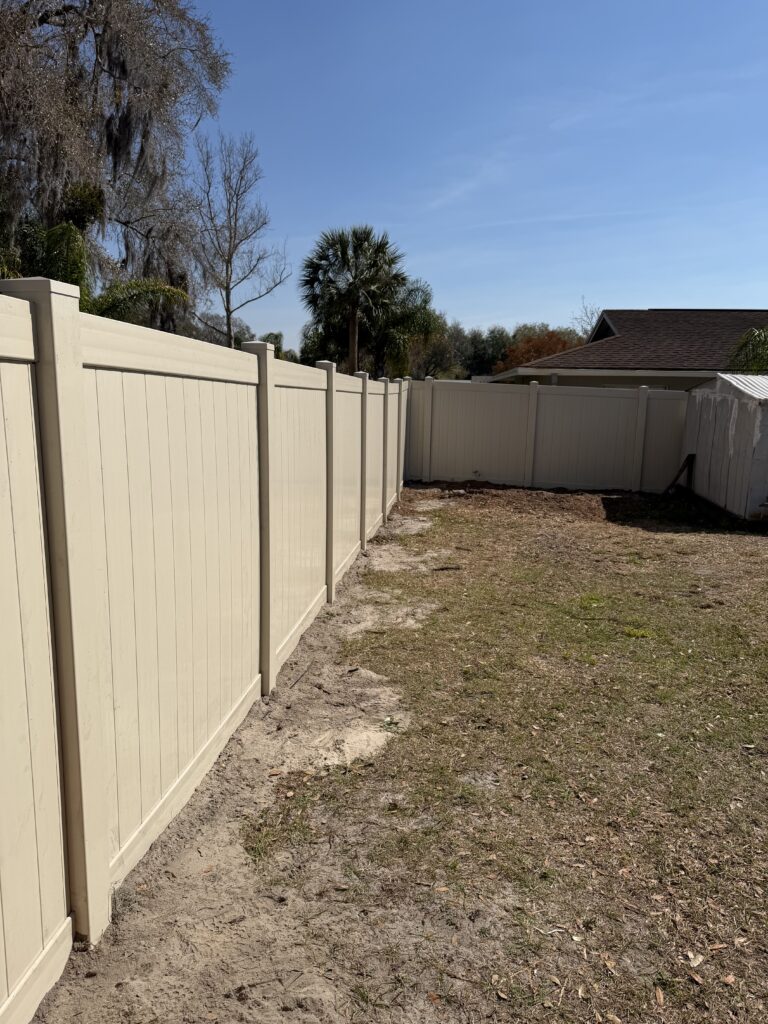
Vinyl fencing expands and contracts with temperature, and that movement is significant enough to matter during installation. A long run of white vinyl can grow or shrink a noticeable amount between a cool January morning and a blazing July afternoon in Central Florida. Quality installations account for that behavior by leaving proper clearance where rails seat into routed posts, giving each panel room to move without buckling, bowing, or pulling loose from the post. Building in moderate temperatures puts the material near the middle of its expansion range, which makes those tolerances much easier to set correctly the first time. Vinyl also becomes more brittle in genuinely cold conditions, though our region rarely reaches that point outside of a brief overnight freeze. Our cool season sits in a comfortable middle zone where the material handles well, cuts cleanly, and stays dimensionally predictable throughout the day. That is one clear reason vinyl privacy fences installed during the dry season tend to hold clean, straight lines for years afterward.
Wood responds to moisture far more than it responds to temperature, and Florida humidity is the variable that controls everything. Pressure treated southern yellow pine arrives from the supply yard carrying a high moisture content, and it will shrink measurably as it dries and releases that water. Boards installed during the peak of the wet season sit saturated for weeks, then shrink hard once the weather finally turns, which opens gaps between pickets and works fasteners loose. In the cool, drier months, lumber sheds moisture at a steadier and more even rate, so the resulting movement is distributed across the fence rather than concentrated. The dry season is also the correct window for staining or sealing, since nearly every product requires dry wood, moderate temperatures, and a rain free period to cure properly. Attempting to seal a fence in August usually means either fighting an afternoon storm or trapping moisture inside the grain where it causes problems later. Sealing wood correctly is the single largest factor in how long a wood fence survives Florida sun and humidity.
Aluminum and chain link are less sensitive to weather during installation, but the crew installing them absolutely is. Setting rails, aligning pickets, squaring corners, and stretching chain link fabric to correct tension all require steady hands and careful, repeated measurement. Heat exhaustion slows a crew down, and quality suffers when everyone is racing to finish and escape a heat index above one hundred degrees. Cool mornings keep the pace consistent through the entire day, and that consistency shows up directly in even picket spacing and properly tensioned fabric. Powder coated aluminum also handles better when the material is not too hot to touch, which protects the finish from scuffs and marring during handling. Chain link tension is easier to judge accurately when the fabric is not sitting in direct sun and expanding under your hands. Small details like these separate a fence that looks good on installation day from a fence that still looks good ten years later.
Predictable Concrete Curing During Cool Weather Fence Replacement
Concrete does not dry, it cures, and that chemical reaction is genuinely sensitive to temperature. When ground and air temperatures climb into the nineties, the mix sets much faster and loses water to evaporation before hydration has finished doing its job. The result is often lower final strength along with visible shrinkage cracking around the top of the footing where it matters most. Crews compensate during summer by working smaller batches and managing water carefully, but every field adjustment introduces another opportunity for error. In the cool season, mix and ground temperatures land much closer to the range concrete actually prefers, which is roughly fifty to eighty five degrees. The reaction then proceeds at a controlled pace and the footing develops the strength it was engineered to reach. Stronger footings mean posts that stay plumb through the next several rounds of Florida storms.
Project timing also improves significantly when concrete behaves predictably from one day to the next. Post footings generally need a full day or two before anyone hangs a gate, applies fabric tension, or loads a rail against them. Rushing that step is one of the most common causes of a gate post that starts leaning six months after installation. Cool season conditions give a crew a reliable window to plan around, so the return trip to hang gates and set hardware lands exactly when it should. Full design strength takes roughly twenty eight days regardless of season, but the early setting period is where weather does the most lasting damage. Protecting that first forty eight hours is the difference between a footing that performs for decades and one that never quite got there. Stable weather makes that protection effortless rather than something the crew has to fight for.
Rain is the other serious threat to fresh concrete, and the wet season delivers it almost daily on a predictable afternoon schedule. A heavy downpour on an uncured footing washes cement paste out of the top of the hole and leaves a weak, crumbly collar right at the soil line. That collar sits exactly where a post experiences the greatest stress when wind pushes against the face of the fence. Saturated soil around a curing footing also reduces the bearing capacity of the surrounding ground, so the entire assembly begins its life with less resistance than the design called for. Dry season installations avoid both of those problems completely and permanently. The footing cures in stable soil, gains strength on schedule, and reaches the following hurricane season fully ready to perform. If your current fence started leaning after a storm, weak or compromised footings are almost always the underlying reason. Ready to get ahead of the next storm season? Click here for our fence replacement service.
How To Plan A Fence Replacement During The Cool Season
Good fence replacement projects are planned several weeks before the first post ever comes out of the ground. Permits, HOA approval, material selection, and utility locates all take time, and none of them can be handled the morning the crew arrives. Starting the paperwork in the fall gives you room to absorb a revision request without pushing the actual build into the rainy months. It also lets you compare materials properly and choose based on performance rather than on what happens to be sitting in a warehouse. Most Central Florida jurisdictions review residential fence permits within a matter of days, but HOA architectural committees frequently meet only once or twice per month. Building your calendar backward from a target installation date keeps the entire project moving without any wasted weeks.
Permits And HOA Approval For A Cool Season Fence Replacement
Nearly every city and county surrounding Winter Garden requires a permit for a new fence, and a full replacement typically counts as new construction. Orange County, Lake County, Osceola County, and Seminole County each maintain their own submittal requirements, and the municipalities inside them frequently layer on additional rules. A current property survey is almost always part of the application, since the reviewer needs to confirm the fence sits inside your property line and clear of any recorded easements. Height limits generate the most confusion, with six feet typical in rear and side yards and four feet common along front yard lines. Corner lots carry additional visibility rules that restrict fence height near intersections and driveway approaches for traffic safety. Getting these details settled before installation avoids the worst outcome in this trade, which is tearing out a brand new fence and rebuilding it at your expense. A contractor who pulls permits regularly in your specific jurisdiction already knows exactly where the tripwires sit.
HOA approval runs on an entirely separate track from the county, and that distinction catches many homeowners off guard. Communities across Horizon West, Windermere, Davenport, and Four Corners commonly restrict fence height, material, color, and even the specific style of picket or rail. Some neighborhoods permit black aluminum only, while others require the finished side of a wood fence to face the street or the adjoining lot. Architectural review committees often meet on a fixed monthly schedule, so a submission that misses a meeting date can add four full weeks to your timeline. Submitting during the fall leaves comfortable room for that kind of delay without pushing your installation into the heart of storm season. It also gives you time to revise the design if the committee requests a change to materials or height. Keep the approval letter in your records, because county inspectors and future buyers sometimes ask to see it.
Utility locates are not optional in Florida, and the service costs nothing. State law requires contacting Sunshine 811 before any digging begins, and the standard notice period is two full business days ahead of the work. Locators then mark buried gas, power, water, and communication lines with paint and flags so the crew can dig safely around every one of them. Fence posts go deep enough to reach shallow utility runs, which makes this step genuinely important rather than a bureaucratic formality. Private lines such as irrigation, landscape lighting, and pool equipment feeds are not covered by the public locate, so point those out to your contractor directly before work starts. A reputable fence company files the 811 request as part of the job and schedules the installation around the marking window. That two day requirement is one more reason to book before the spring rush compresses everyone’s calendar into a bottleneck.

Choosing Fence Materials For A Cool Season Fence Replacement
Material choice should begin with what the fence actually needs to accomplish and only then move toward appearance. Vinyl delivers complete privacy, resists rot and insect damage, and never requires paint, which explains its popularity across Winter Garden and Ocoee. Its main weakness is impact resistance, since a hard hit from a falling limb tends to crack a panel rather than dent it. Aluminum offers a clean, open look, handles wind exceptionally well because air passes straight through it, and does not rust the way steel eventually will. It provides almost no privacy, so it performs best around pools, along front yards, and in communities that require an open sightline. Both materials carry a higher upfront cost than wood along with a substantially lower maintenance burden across their service life. For most homeowners, the right answer comes down to how much privacy the property needs and what the HOA is willing to approve.
Wood remains the most affordable way to achieve six feet of solid privacy, and it still dominates a great many Central Florida neighborhoods. Pressure treated southern yellow pine is the regional standard because it resists termites and fungal decay far better than untreated lumber ever could. Posts should carry a ground contact treatment rating, since the section sitting right at the soil line is where rot almost always begins its work. Plan to seal or stain the fence within the first year and then repeat that process every two to three years depending on sun exposure and irrigation overspray. Skipping maintenance in the Florida climate shortens the usable life of a wood fence dramatically and visibly. Boards will also cup and check somewhat over time, which is normal behavior for solid wood rather than a defect in workmanship. Homeowners who accept that maintenance rhythm consistently get excellent value out of a wood privacy fence.
Chain link still earns its place on large properties, pet containment projects, and commercial sites where budget and function outrank appearance. Galvanized fabric holds up well at inland locations, and black vinyl coated fabric visually recedes against landscaping and tree lines. Composite fencing occupies the premium end of the market and blends wood fiber with polymer to deliver a wood appearance without the sanding and staining cycle. It costs more per linear foot than nearly every alternative, so it makes the most sense for homeowners planning to stay in the property for many years. Ordering during the cool season helps as well, because supply houses are working through winter inventory rather than digging out from a spring backlog. Special order colors, custom heights, and oversized gate frames all arrive faster when overall demand is lower. That timing advantage disappears completely once the March phone calls start rolling in. Not sure if a repair would solve the problem instead? Click here for our fence repair service.
Scheduling Your Fence Replacement Before The Spring Rush
Fence demand across Central Florida follows a highly predictable annual curve. Calls surge in March and April when homeowners start spending time outdoors again, and they surge a second time immediately after every named storm. During those peaks, lead times stretch out, crews run long days in difficult heat, and the best installation windows fill within hours of opening. Booking during the cool season puts you well ahead of that curve, and it usually means receiving a firm date rather than a rough estimate that moves twice. It also means the crew arriving at your home is not working its fourth job of the day in ninety five degree heat with the sun beating down. Quality work depends heavily on unhurried work and a crew with time to check every measurement. Scheduling early is the simplest and cheapest way to protect that quality.
A realistic cool season timeline generally looks something like the following. Estimate and layout happen in week one, HOA submission and permit application go out in weeks two and three, approval and material ordering land in week four, and installation follows shortly after that. Standard residential jobs running one hundred fifty to two hundred fifty feet typically take one to three days on site once every approval is in hand. Custom gates, sloped or terraced lots, and buried debris or old concrete in the ground can each add time to the schedule. Starting the process in October or November leaves comfortable margin for all of those variables without stress. Waiting until May drops your installation directly into the afternoon storm pattern and every delay that comes with it. The calendar does considerably more work on a fence project than most homeowners realize.
Replacing before storm season carries a practical structural benefit that goes well beyond convenience. A fence installed with properly cured footings and correct post depth is far more likely to survive high wind than one thrown together against a deadline. Central Florida sits in a wind zone where the Florida Building Code requires design speeds well above one hundred miles per hour, and fence construction should reflect that reality. Deeper footings on corner and gate posts, correct post spacing, appropriate fastener selection, and adequate concrete volume all contribute to that performance. Doing that work in November means the fence has months to fully cure and settle before June arrives. Rebuilding in September, by contrast, means installing during the exact conditions that destroyed the previous fence. Getting ahead of the season is a strategy rather than simply a preference.
Why You Need A Professional Fence Replacement This Cool Season
Fence replacement looks simple from the street and almost never is once the work begins. Property lines, permits, HOA rules, buried utilities, post depth, footing strength, and gate hardware alignment all have to be correct at the same time. A mistake in any one of those areas shows up months later as a leaning post, a dragging gate, or a correction notice from the county. Hiring a licensed and insured fence contractor moves all of that risk off your shoulders and onto a company that carries coverage for it. It also gets the project completed in days rather than stretching across four consecutive weekends. The cool season is the ideal window to have that work done properly and completely.
What A Professional Fence Replacement Crew Handles For You
A professional fence replacement begins before any digging with a full walk of the property line and a review of your recorded survey. The crew confirms setbacks, identifies easements, and marks the layout so you can see exactly where the finished fence will sit. Sunshine 811 receives the locate request on schedule, and private irrigation and lighting lines get flagged separately by the homeowner. Permit applications are submitted with the correct drawings and specifications attached the first time around. That front end work prevents nearly every expensive surprise a fence project can produce.
Demolition and disposal are included as part of the job, and that portion is heavier work than it appears from the curb. Old panels, posts, concrete footings, and hardware all have to physically leave the property, and a full replacement can easily generate several thousand pounds of debris. New posts are then set to the depth your soil conditions and local wind load require, with corner and gate posts going deeper than standard line posts. Footings get poured, checked for plumb, and given adequate time to cure before anything applies load to them. Panels, rails, and pickets follow only once the posts are genuinely solid in the ground. Gate hardware is installed last so it aligns correctly against fully cured posts and swings true from the first day.
Cleanup and inspection close out the project properly. A good crew rakes the entire work area, runs a magnet sweep for dropped fasteners, and hauls away every piece of the old fence. County inspections, where required, are scheduled and passed by the contractor rather than left sitting on your task list. You receive a walkthrough covering gate adjustment, maintenance timing, staining schedules, and exactly what the warranty does and does not cover. That handoff is what turns a finished fence into a genuinely finished project.

Signs You Should Schedule A Fence Replacement Right Now
Leaning posts are the clearest signal that replacement has become necessary. A post that visibly moves when you push against it has lost the integrity of its footing, and one failed post usually means several others are close behind. Rot at the soil line is another reliable indicator, and you can check it easily by pressing a screwdriver into the wood just above grade. Soft, spongy wood in that area means the post is holding on by very little remaining material. Fences displaying this pattern in more than a few locations have passed the point where continued repair makes any financial sense.
Widespread board and panel damage tells you the same story from a different angle. Cracked, cupped, warped, or missing pickets spread across multiple sections indicate a fence that has reached the end of its service life rather than one isolated problem area. Gates that drag, refuse to latch, or need lifting to close are almost always reporting a post problem rather than a hardware problem. Rust running through chain link fabric and vinyl that has gone chalky and brittle both point toward the same conclusion. Once failures spread beyond one or two spots, replacement costs less over time than another round of repairs.
Storm damage deserves its own careful evaluation every fall. A fence that survived hurricane season while visibly shifting is a fence unlikely to survive the next season intact. Sections pushed out of plane, footings loosened in the surrounding sand, and rails pulling away from posts all point toward structural fatigue rather than cosmetic wear. Replacing during the cool months means your new fence is fully cured, settled, and ready well before June arrives. Waiting until after the next storm means competing with every other homeowner in Central Florida for the same limited pool of crews and materials.
Why Choose Fence Pros For Your Fence Replacement
Fence Pros operates out of Winter Garden and serves Ocoee, Windermere, Horizon West, Clermont, Apopka, Kissimmee, Oakland, Minneola, and everywhere else within about an hour of our shop. That local footprint means we already know the permit process in each jurisdiction and the architectural standards common throughout these communities. We handle both residential and commercial projects, and we select materials specifically for Florida sun, humidity, sandy soil, and wind exposure. Estimates are free on every fence project we quote, with no pressure and no obligation attached. Our focus stays on clean work, strong builds, and results that continue performing years down the road.
We build the parts nobody ever sees with the same care we apply to the parts everyone sees from the street. Post depth, footing dimensions, and hardware selection get matched to your actual soil and wind exposure rather than to a generic company template. Gates are hung only after footings have cured, so they swing correctly on day one and continue swinging correctly through the years. Job sites get cleaned thoroughly at the end of every day, and all old fence material leaves with our trucks. Consistent five star service is the standard we hold every crew to on every project.
The cool season window is open right now, and it remains the best time all year to replace a fence anywhere in Central Florida. Booking early gets you a firm installation date, better material availability, and a completed fence that is fully cured long before storm season returns. Planning a fence on a property that has never had one before? Click here for our fence installation service. Our team will walk your property, review your HOA requirements, and give you a clear written estimate with no guesswork involved. Call Fence Pros at (407) 580-8353 or email info@fenceprosorlando.com to schedule your free estimate at 700 Tangelo Ct, Winter Garden, FL 34787.