
How To Spot Cheap Fence Work Before You Sign A Contract
Late summer is one of the busiest stretches of the year for fence quotes in Central Florida, and it brings out a wave of crews that price low, work fast, and leave problems behind. Cheap fence work almost never looks cheap on the day the last panel goes up; it looks fine for a few months, and then the posts start to lean, the gate drags across the concrete, and the boards cup after the first long run of afternoon storms. By the time the damage is obvious, the crew has moved on and the paperwork you signed gives you nothing to stand on. The good news is that low quality work leaves clues long before anyone puts a shovel in your yard. Those clues sit in the written estimate, in the material list, in the way a company handles permits and utility locates, and in the finished jobs that company has already left around Winter Garden, Ocoee, and Horizon West. Reading those clues takes about fifteen minutes of attention, and it is the single highest value thing a homeowner can do during the bidding process. This guide walks through exactly what to look for, in the order you will run into it, so you can tell the difference between a fair price and a price that only looks fair on paper.
Warning Signs of Cheap Fence Work Inside a Fence Contract
The contract is where cheap fence work is easiest to catch, because everything a contractor plans to skip shows up as something missing from the page. A quality estimate reads like a build plan, with material grades, post sizes, hole depths, spacing, gate hardware, and cleanup all spelled out in plain terms. A cheap estimate reads like a receipt, with one line for footage, one line for a gate, and a total at the bottom. That difference is not a formatting preference; it is the contractor telling you how much accountability he is willing to accept. Two bids can sit within a few hundred dollars of each other and still describe completely different fences, and the only way to see it is to compare the details side by side. Anything a contractor will not put in writing is something you have no way to enforce later.
Cheap Fence Work Starts With Vague Material Specs in the Contract
The fastest way to spot cheap fence work is to look for the words a contractor did not write. A quote that says “wood privacy fence” tells you nothing, because that phrase covers everything from a fence built with ground contact rated 4×6 posts and three horizontal rails down to a fence built with thin above ground lumber and two rails that will sag inside a year. In Florida, pressure treated lumber comes in different use categories, and the material rated for above ground use is not the same product as the material rated for ground contact burial. Posts set in our sandy, wet soil need ground contact rated treatment, and the tag stapled to the end of every board states which category it carries. A serious estimate names the species, the treatment rating, the post dimensions, the rail count, and the picket thickness. A cheap estimate leaves all of that open so the crew can buy the least expensive thing on the rack that morning. If you ask for those details and the salesperson tells you not to worry about it, you have learned everything you need to know.
The same problem shows up in vinyl, aluminum, and chain link, just with different vocabulary. Vinyl fence panels vary widely in wall thickness and in the quality of the resin, and the better products use virgin vinyl with UV inhibitors blended in rather than recycled material that chalks and yellows under Florida sun. Quality vinyl also uses aluminum stiffeners inside the bottom rails of tall privacy sections and inside the gate posts, which is what keeps a six foot panel from bowing during a summer squall. Chain link is graded by wire gauge, and 9 gauge fabric is noticeably heavier and more puncture resistant than the 11 gauge or 11.5 gauge sold as residential grade. Aluminum ornamental fence is graded by rail and picket wall thickness along with the quality of the powder coat finish applied over the metal. A contractor who works with these products every day can rattle off those specs without hesitating. One who cannot is buying whatever a supplier has on clearance.
Ask each bidder to write the specs into the contract before you compare prices, and then compare the bids again. It is common for the cheapest number to jump several hundred dollars once the contractor has to commit to real materials on paper, and it is just as common for the middle bid to turn out to be the best value in the group. Pay attention to what happens after you make the request, too. A contractor who welcomes the question is confident in what he sells. A contractor who gets irritated, changes the subject, or pushes you to sign today is protecting a margin that depends on you not looking closely. You are not being difficult by asking; you are doing the one thing that separates a fence that lasts twenty years from one that needs replacement before your next roof. Ready to compare a detailed, itemized quote against the vague ones sitting on your kitchen counter? Click here for our fence installation service.

Cheap Fence Work Hides in the Post Depth and Concrete Line Items
Everything above the ground is held up by everything below it, so post setting is where cheap fence work does the most long term damage. A standard rule in the trade is that roughly one third of the total post length belongs in the ground, which puts a six foot privacy fence somewhere around thirty inches deep in most Central Florida yards. The hole diameter matters just as much as the depth, and a properly sized hole runs about three times the width of the post so the concrete forms a real collar rather than a thin shell. Sandy soil drains fast but grips poorly, which means a shallow post has almost nothing resisting the wind load pushing against a solid privacy panel. When a crew cuts depth from thirty inches to eighteen, the fence still stands up straight on installation day and the homeowner has no way to see the difference. Then the first serious storm arrives and half the line leans toward the neighbor’s yard. Ask every bidder to state the hole depth and diameter in writing, and treat the answer as a direct measure of how the company thinks.
Concrete is the second place corners get cut, and there are several ways to do it. Some crews pour dry mix into the hole and let groundwater set it, which produces uneven strength and voids throughout the footing. Others use a single small bag where the hole calls for two, or skip concrete entirely on line posts and use it only on corners, ends, and gates. Correct practice is a properly mixed footing that fills the hole and gets crowned slightly above grade so water runs away from the post instead of pooling around it. That crown detail is small, costs nothing, and adds years to a wood post by keeping the base out of standing water. Cheap crews leave the concrete flat or dished below grade, and every rainstorm after that sits against the wood. When you walk a company’s past job, look at the base of the posts and you will see immediately which approach they use.
Post spacing belongs in this same conversation because it changes the wind load on every component. Most residential fences are built with posts spaced six to eight feet on center, and tighter spacing produces a noticeably stronger fence, particularly on solid privacy panels that catch wind like a sail. A contractor who stretches spacing to save on posts is quietly reducing the strength of your fence while charging you the same footage price. Hurricane season in Florida runs into late November, so a fence installed this month faces its first real test within weeks. The cost difference between eight foot spacing and six foot spacing on an average yard is small; the difference in how the fence holds up over a decade is not. Get the spacing written into the contract along with the depth and the concrete quantity, and you have removed the three most common shortcuts in the entire trade.
Cheap Fence Work Shows Up in Missing Permit, License, and Insurance Details
Permitting is where a lot of low bids quietly stop being a bargain. Most municipalities in our service area, including Winter Garden, Ocoee, Apopka, Clermont, and unincorporated Orange County, require a permit for a new fence, and the review covers height limits, setbacks, easements, and corner visibility triangles. Front yard height limits are typically lower than side and rear limits, and drainage easements often prohibit permanent structures altogether. A contractor who tells you a permit is unnecessary is either unfamiliar with local code or hoping to avoid an inspection that would expose his post depth. The homeowner carries the consequences of that decision, not the crew, because code enforcement action lands on the property owner. A fence built inside an easement can be ordered removed at your expense years after installation. If your neighborhood has an HOA, architectural approval usually runs on a separate track and needs its own submission, and a good contractor will tell you that upfront.
Utility location is not optional and it is not a formality. Florida law requires notification to Sunshine 811 before excavation, with two full business days of notice, and the service is free to the homeowner and the contractor. Fence crews dig dozens of holes across a property line, which puts them right in the path of buried gas, electric, cable, irrigation, and water lines. A crew that shows up the same day you sign and starts digging has skipped that step entirely, and a struck gas line is a genuine emergency rather than an inconvenience. Marked lines also change the layout in useful ways, because posts sometimes need to shift a foot or two to clear a service run. Any contractor who treats locates as a waste of time is telling you how he handles every other rule.
License and insurance verification takes one phone call and protects you from the most expensive scenario in the entire process. Ask for the certificate of insurance and confirm both general liability and workers compensation coverage, and ask the insurance agent directly rather than accepting a printed copy that may be expired or altered. If a worker is injured on your property and the company carries no workers compensation coverage, your homeowners policy can become the target. Florida law also limits how long a contractor can sit on a large deposit, and licensed contractors who collect more than ten percent down are required to apply for permits within a defined window and begin work within a defined period after that. Watch the deposit request closely, because demands for half the job in cash before any material arrives are a classic pattern. Finally, ask about lien releases; under Florida construction lien law, unpaid suppliers and subcontractors can place a lien on your home even after you have paid the contractor in full, and collecting signed releases at final payment closes that door.
How To Inspect a Fence Company’s Past Jobs for Cheap Fence Work
Photos on a website are taken on installation day, when even a poorly built fence looks straight and clean. Real evaluation happens on a job that has been standing through at least one Florida summer, because heat, humidity, ultraviolet exposure, and daily storms expose every shortcut within about twelve months. Ask any contractor you are considering for two or three addresses of fences they installed one to three years ago in your area, then drive by and spend ten minutes looking. You do not need trade experience to do this well; you need to know which four or five things to look at. Sighting down a fence line, working a gate, and looking closely at the fasteners will tell you more than any review site. A company that hesitates to give you older addresses is telling you their work does not age well.
Cheap Fence Work Is Easiest To Spot Along the Post Line
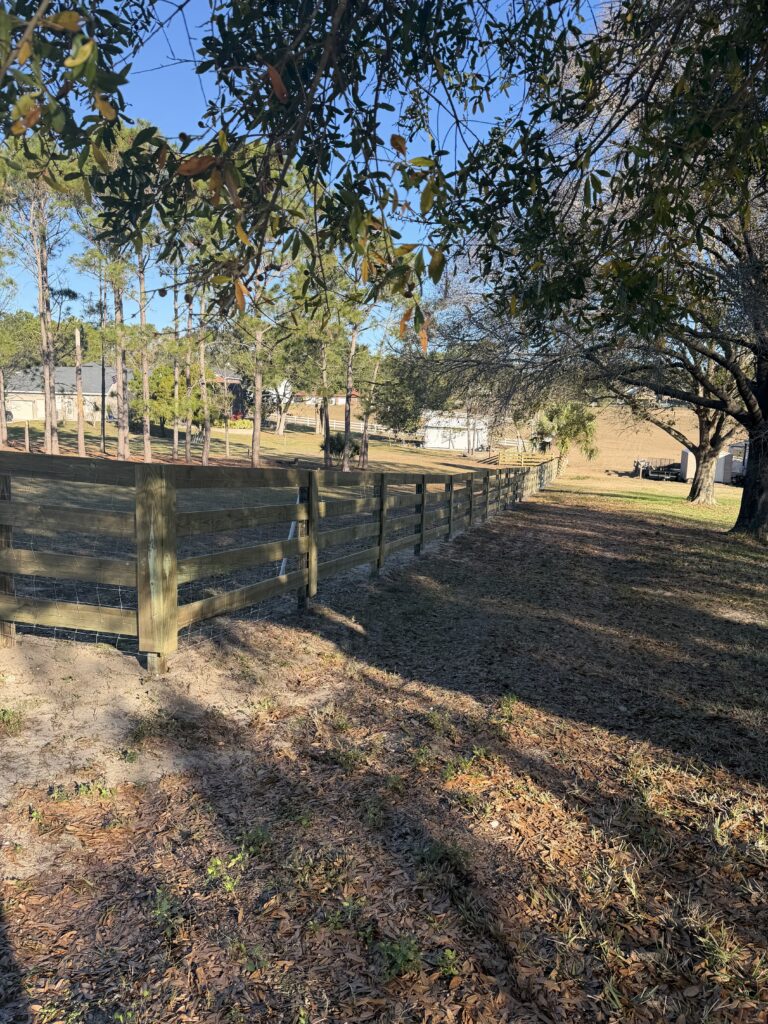
Stand at one end of a finished fence and sight straight down the line at eye level. A properly built fence reads as one continuous plane, with posts in alignment and tops running at a consistent height relative to the grade. Cheap fence work shows up as posts that wander in and out of line, tops that rise and fall unevenly, and sections that lean at different angles from their neighbors. Small variations happen on any long run, especially across changing grade, but a wavy line is the signature of a crew that set posts by eye instead of running a string line and checking each post for plumb before the concrete set. Leaning posts on a fence under three years old are a straightforward sign of shallow footings. Look particularly at corner and end posts, because those carry the most load and fail first.
Next, look at where the fence meets the ground along its length. On sloped ground there are two correct methods: racking, where the panel follows the grade at an angle, and stepping, where each section stays level and drops down at the posts. Both are legitimate and the right choice depends on the material and the slope. What is not legitimate is a fence that follows neither method, leaving wide irregular gaps under some sections and boards buried in the dirt under others. Buried wood wicks moisture continuously and rots from the bottom up regardless of the treatment rating. Consistent ground clearance across the whole run, usually a couple of inches on wood, indicates a crew that planned the layout before building rather than improvising panel by panel.
Then look down at the base of several posts. You want to see concrete crowned slightly above grade and sloped away from the post, not a dished pocket holding dirt and water. Push firmly against the middle of a panel and against a post; a well built fence flexes slightly and returns, while a poorly footed one moves at the base or produces visible rocking. On vinyl and aluminum, check that posts are not spinning or wobbling in their footings, which happens when the hole was too small for the concrete to lock in. If you can move a post by hand two years after installation, that fence will not survive a serious wind event. Seeing this on a fence you already own instead of a stranger’s? Click here for our fence repair service.
Cheap Fence Work Almost Always Shows Up in the Gates
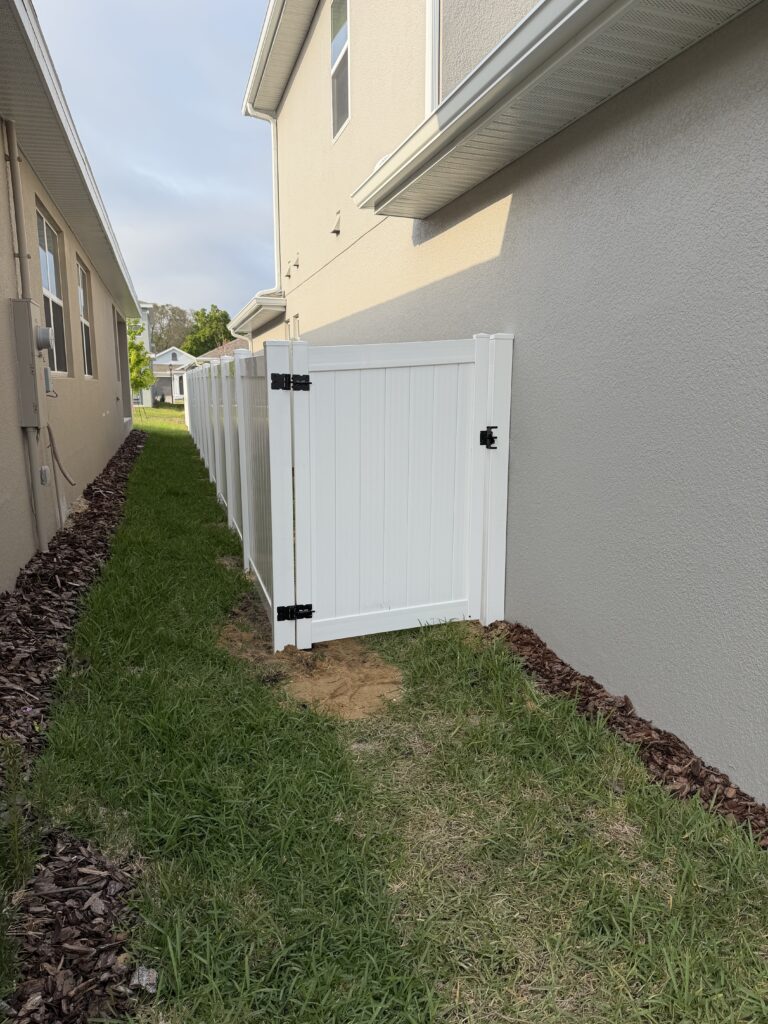
Gates are the hardest part of any fence to build correctly and the part homeowners touch every single day, which makes them the most reliable indicator of workmanship. Open and close every gate you can reach on a company’s past job. A well built gate swings freely through its full arc, latches without lifting or shoving, and sits with an even reveal along the latch side from top to bottom. A gate that drags on the ground, needs a knee to close, or shows a wedge shaped gap that is tight at the top and wide at the bottom has sagged, and sagging is nearly always a construction problem rather than normal wear. The weight of a gate pulls constantly against the hinge side, and everything about a proper gate build exists to resist that pull. Cheap crews build gates like fence panels with hinges attached, and the results appear within one season.
Correct gate construction starts with the posts. Gate posts carry far more load than line posts and should be larger, often 6×6 on a wood fence, set deeper and in more concrete than the rest of the line. On vinyl, gate posts should have aluminum stiffeners or a concrete filled core, because hollow vinyl alone will flex under a swinging gate. The gate frame itself needs bracing, and there are two correct approaches. A rigid wood diagonal brace runs in compression from the bottom of the hinge side up to the top of the latch side. A steel cable and turnbuckle kit works in tension and runs the opposite direction, from the top of the hinge side down to the bottom of the latch side. A gate with no bracing at all, or with a brace installed backward, will sag no matter how good the rest of the fence is.
Hardware is the third element and the cheapest place to save money at your expense. Tall or wide gates need three hinges rather than two, and the hinges, screws, and latch should be rated for exterior use and appropriate for the material. Central Florida humidity, irrigation overspray, and salt in the air near the coast will eat light duty plated hardware quickly, leaving rust streaks down a new fence within a year. Look for rust bleed under hinges and latches on any job you inspect, since that stain is permanent on vinyl and paint. Gates around pools carry an additional and non negotiable requirement, because Florida pool barrier code calls for self closing and self latching hardware with the release positioned out of a small child’s reach and the gate swinging away from the pool. A contractor who does not raise pool code without being asked should not be building your pool enclosure.
Cheap Fence Work Leaves Evidence in Fasteners and Framing
Get close enough to see the fasteners, because this is where budget crews save real money and assume nobody will look. Modern pressure treated lumber uses copper based preservatives that corrode ordinary electroplated fasteners through galvanic action, so the correct choice is hot dipped galvanized or stainless steel. Ring shank nails or exterior rated screws hold far better over time than smooth shank nails, which back out as the wood cycles through wet and dry seasons. Rust streaks running down fresh pickets, nail heads standing proud of the surface, and split board ends all point to the wrong fastener or a nail gun run at too high a pressure. None of this is visible in a listing photo, and all of it is obvious from three feet away. On a two year old fence, the fastener condition tells you exactly what the crew bought.
Framing details matter just as much. A six foot wood privacy fence performs far better with three horizontal rails than with two, because the middle rail keeps pickets from cupping and bowing as they dry out. Rails should be joined at the posts rather than butted together mid span, and joints should be staggered rather than stacked. Check the top of the fence for a consistent picket height and for gaps that have opened between boards, which indicates lumber that was installed soaking wet and shrank as it dried. Some gapping is normal on any wood fence and does not mean poor work by itself, but wide uneven gaps combined with cupping and splitting mean the crew used low grade material. On chain link, check that the fabric is stretched tight with a tension bar at every terminal post, secured with brace bands, and tied at regular intervals along line posts and the top rail. Loose, wavy chain link fabric means the crew never used a stretcher.
Finish work is the last tell and often the most revealing. Look at how the fence terminates against the house, at how it transitions around obstacles, and at how cuts were made around irrigation heads, meters, and utility boxes. Quality crews make clean square cuts, cap exposed post tops, and leave the site free of concrete spoil, wire clippings, and lumber scraps. Cheap crews leave ragged cuts, uncapped hollow posts that collect rainwater, and piles of excavated dirt spread across the lawn. Ask the homeowner, if you can reach them, how the company handled the punch list and any callbacks. A contractor’s response to a small problem six months later says more about the company than anything printed on a brochure.
Why You Need a Fence Contractor Who Writes Down the Details
Every warning sign in this article traces back to one question: did the contractor commit to specifics before the money changed hands? A clear written scope removes the guesswork, gives you real recourse, and makes it possible to compare bids honestly instead of by price alone. It also filters the market for you, because companies that build well are comfortable documenting how they build. Fence work is not a purchase you make often, and the cost of getting it wrong is not the difference between the bids; it is the full price of doing the job again a few years early. Choosing carefully now costs you an afternoon of reading and a few phone calls. Choosing on price alone can cost you the entire investment.
A Written Scope of Work Is Your Best Defense Against Cheap Fence Work
A complete scope of work names the material grade, post size and spacing, hole depth and diameter, concrete quantity, rail count, fastener type, gate construction and hardware, and the plan for cleanup and haul away. It also states who pulls the permit, who calls in the utility locates, and what the schedule looks like from deposit to completion. Payment terms belong in that same document, with a reasonable deposit and a final payment tied to completion rather than to a calendar date. When all of that is written down, an honest disagreement has an answer, and you are not arguing about what somebody remembers saying in the driveway. That document is worth more to you than any verbal guarantee.
Warranty language deserves the same attention. A meaningful warranty separates the manufacturer’s material coverage from the contractor’s coverage on labor and installation, and it states the term for each in plain language. Material warranties on vinyl and aluminum often run long, but they cover defects in the product and do nothing about a post that was set too shallow. Labor coverage is the part that protects you from installation errors, and it only means something if the company is still in business to honor it. Ask how long the company has operated locally and under how many names.
Change orders are the last piece and the one homeowners overlook most often. Yards produce surprises, including buried debris, tree roots, rock, unmarked irrigation lines, and property corners that are not where anybody assumed. A professional contractor documents the change, prices it, and gets your approval before proceeding. A cheap crew keeps digging and hands you a larger invoice at the end. Agreeing on that process before work starts keeps a small surprise from becoming a dispute.
Paying for Quality Fence Work Costs Less Than Repairing Cheap Fence Work
The math on fencing is simple once you look past the first invoice. A properly built wood privacy fence in Central Florida can serve fifteen to twenty years with basic maintenance, while a poorly built one often needs major repair inside three to five. Vinyl and aluminum last longer still when the posts underneath them are set correctly, since the failure point on those systems is almost always the footing rather than the material. Replacing leaning posts means demolition, disposal, and rebuilding sections you already paid for once. The savings from the low bid disappear on the first repair visit.
There is also a cost that never appears on an invoice. A sagging gate, a leaning line, and rust stained pickets pull down the appearance of an otherwise well kept property, and buyers notice fences during a walkthrough. Insurance and liability enter the picture as well when a pool barrier gate fails to latch or a section blows into a neighbor’s yard during a storm. Those are not hypothetical outcomes in a state that spends half the year in hurricane season. A fence is a safety component of your property, not just a boundary marker.
The practical takeaway is to compare bids on value rather than on the bottom line. When one number sits far below the rest, something has been removed from the build, and your job is to find out what. Sometimes the answer is legitimate and reflects lower overhead or a shorter drive. Often the answer is depth, concrete, lumber grade, or a permit nobody intends to pull. Have a fence that already needs more than a repair? Click here for our fence replacement service.
Why Choose Fence Pros for Fence Work in Winter Garden and Orlando
Fence Pros builds residential and commercial fences out of Winter Garden and serves communities within about an hour of our shop, including Ocoee, Windermere, Horizon West, Clermont, Apopka, Kissimmee, Davenport, Dr. Phillips, Altamonte Springs, Casselberry, Oakland, Minneola, Mascotte, Four Corners, Forest City, and Pine Hills. We select materials built for Florida weather, because a fence here contends with intense ultraviolet exposure, daily summer rain, sandy soil, and storm season wind loads every year. Our estimates are free, and they are written to show you what you are actually buying rather than a single number on a page. We handle wood, vinyl, aluminum, and chain link for both residential and commercial properties.
Clean work and strong builds are the standard we hold ourselves to on every job, and that starts underground where nobody sees it. We set posts at appropriate depth with properly mixed and crowned concrete, brace gates so they stay square, and use fasteners rated for treated lumber and Florida humidity. We work through permits and property line questions with you before the first hole is dug, and we leave the site clean when the last panel goes up. Consistent five star service is what we aim for on every project, and it comes from doing the small things correctly the first time.
If you are holding two or three fence bids right now and trying to figure out which one is real, we are glad to walk your property, measure the layout, and give you an itemized quote you can compare line by line against the others. There is no charge for the estimate and no pressure to sign the same day. We would rather you understand exactly what you are paying for, because informed customers make the best long term clients. Call Fence Pros at (407) 580-8353 or email info@fenceprosorlando.com to schedule your free estimate, and we will show you in writing what a fence built to last actually includes.