
How To Make Your Backyard Feel Bigger With The Right Fence
Most Central Florida backyards are smaller than the ones homeowners grew up with, and the fence you choose has more to do with how big that space feels than almost anything else you can buy. A solid wall of pickets pulled tight around a compact lot turns the yard into a box, while the right height, style, and color can push the visual boundary outward and make the same square footage feel open and usable. This matters in Winter Garden, Horizon West, and the newer communities around Ocoee and Windermere, where lot sizes are tight and neighboring homes sit close enough that privacy still has to be part of the plan. The good news is that you do not have to choose between privacy and space; you just have to be deliberate about where each one goes. Late summer and early fall is a smart time to plan this work, since the rainy season is winding down and the ground is still soft enough for clean post digging. It is also the stretch when many homeowners finally get outside again after the July heat and realize their yard is not working the way they want it to. Below is how professional fence contractors approach small yards, and what actually makes a difference once the posts are in the ground.
How the Right Fence Makes a Small Backyard Feel Bigger
Making a backyard feel bigger comes down to controlling where the eye stops. Every solid surface at eye level acts as a hard edge, and the closer that edge sits to your patio or back door, the smaller the yard reads. Fences that let light and sight lines pass through push that stopping point further away, which is why two yards of identical size can feel completely different depending on the fence around them. Height, style, spacing, and color all pull on that same lever. The trick is applying privacy only where you actually need it and keeping the rest of the perimeter as visually light as your comfort level allows. A good fence company will walk the yard with you and look at it from the seating areas and the kitchen window rather than from the street.
Fence Height Choices That Make a Backyard Feel Bigger
Height is the first thing homeowners get wrong when they want a small yard to feel open. A solid six foot privacy fence sitting only 15 feet from the back patio creates a wall that your eye hits immediately, and the whole space reads as a container rather than a yard. Dropping that same run to four feet along the side yards keeps pets and children contained while letting your sight line travel past the property line and into the neighboring green space, which the brain reads as extra room. Orange County and most Central Florida municipalities commonly allow up to six feet in rear and side yards and limit front yard fencing to around four feet, so there is usually legal room to mix heights across the property. Many homeowners in Winter Garden and Horizon West put six feet only directly behind the patio or across from a neighbor’s window, then step down to four feet for the rest of the perimeter. That single decision can make a 40 foot deep yard feel closer to 60 without changing a square inch of actual space. Always confirm your specific zoning district and HOA documents before ordering material, because community standards in newer neighborhoods are frequently stricter than county code.
Stepping fence height is also a practical answer for lots that back up to a pond, a conservation easement, or a shared open area. Those views are the most valuable feature a small yard can borrow, and blocking them with solid panels is the fastest way to shrink your space. An aluminum picket fence at four or five feet along the rear property line preserves the view completely while still meeting containment needs, and Florida homeowners who back up to water almost always regret going solid there. If wind and privacy are both concerns, a taller solid section can be limited to the two side runs where neighbors actually see in. The rear stays open, the sides stay private, and the yard gains depth. Fence Pros builds this kind of mixed height layout regularly across Horizon West and Windermere, and the transitions look intentional when the posts and rails are matched properly.
There is a safety consideration that overrides style when a pool is involved. Florida requires residential pool barriers to be at least four feet tall with no gaps that would allow a four inch sphere to pass through, and gates must close and latch on their own with the latch mounted at least 54 inches above the ground. That code applies to the barrier surrounding the water, which in most yards is the perimeter fence itself. Aluminum picket fencing satisfies those requirements while staying visually open, which is exactly why it is the default around pools in this part of the state. If your yard has a pool or you plan to add one, build the fence to that standard from day one rather than retrofitting later. Ready to talk through the right height for your lot? Click here for our fence installation service.
Fence Style and Spacing That Make a Backyard Feel Bigger
Style controls how much visual air passes through the fence, and that airflow is what separates an open yard from a closed one. A standard solid board privacy fence blocks everything, which is the correct choice for a hot tub or a bedroom window but the wrong choice for an entire small perimeter. Spaced picket fencing, whether wood or aluminum, keeps the boundary defined while letting your eye read the space beyond it, so the yard borrows depth from the neighboring lot. Shadowbox fencing sits in the middle, with boards alternating on either side of the rails so the fence looks finished from both directions and still allows air and filtered light to move through. That airflow is not just a design benefit in Florida; a fence that lets wind pass takes far less pressure during a summer storm than a solid panel does. Homeowners in Kissimmee, Clermont, and Apopka often pick shadowbox for exactly that combination of privacy and wind performance. The gap size matters more than most people expect, and a half inch difference between boards changes how open the finished run looks.
Board orientation is the other lever, and it is one that gets overlooked. Horizontal board fencing pulls the eye sideways along the length of the run, which stretches a narrow yard visually the same way a horizontal stripe widens a room. Vertical boards do the opposite by drawing attention upward and emphasizing the height of the barrier. In a yard that is wide but shallow, horizontal runs along the rear line can be a real improvement, though the material has to be selected carefully because horizontal boards need closer post spacing and better fasteners to stay flat in Florida humidity. Pressure treated pine will move more than cedar in this climate, and horizontal installations show that movement clearly. A contractor who builds horizontal fencing regularly will space posts tighter and use a heavier board to keep the lines straight over time. It is a more involved build, and the price reflects that, but the visual payoff on a small lot is real.
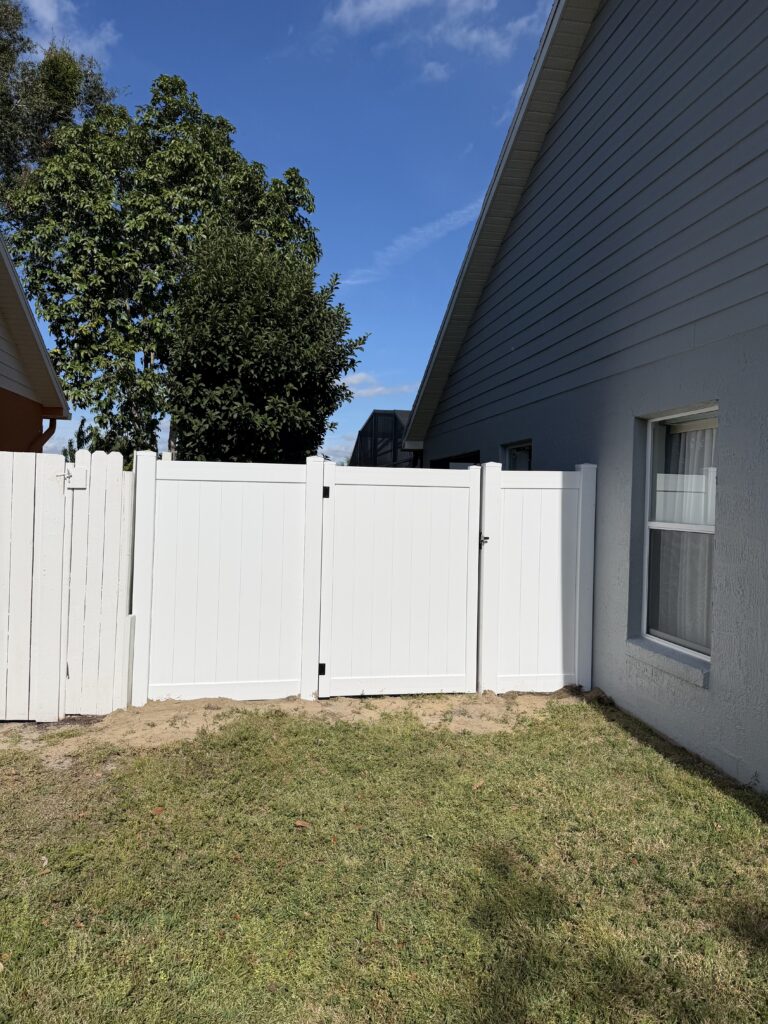
Top design also changes the feel of the run more than the cost would suggest. A flat top on a solid privacy fence reads as one continuous mass, while a lattice top or an open picket top section breaks that mass and lets light through at exactly the height where your eye travels. On vinyl, a solid six foot panel with a two foot open lattice section above the solid area gives you full privacy where it counts and openness above it. On wood, capping the fence with a horizontal top rail and trim board makes the run look finished and intentional instead of raw, which reads as more space rather than less. Scalloped or arched top sections can work, but they draw attention to the fence itself, and in a small yard you generally want the fence to recede. Simple, clean, and consistent almost always makes a compact yard feel larger than something ornate.
Fence Color and Material Choices That Make a Backyard Feel Bigger
Color does a surprising amount of work in a small backyard. Dark colors recede visually, which is why a black aluminum fence practically disappears against a hedge line or a stand of trees and leaves the eye to focus on the landscape instead of the barrier. Bright white vinyl does the opposite and defines the boundary sharply, though it reflects light well and can genuinely brighten a shaded yard under mature oaks. Natural wood ages to a soft gray in Florida sun unless it is sealed, and that weathered tone tends to blend in rather than stand out. Tan and khaki vinyl is a middle option that reads warmer than white and does not show pollen or dust the way white panels do during spring. If your yard is small and heavily planted, dark is usually the safer bet; if it is small and shaded, a lighter color may serve you better.
Material choice affects both appearance and how the fence holds up in Central Florida conditions. Vinyl resists rot, termites, and the constant moisture cycles that break down wood here, and it never needs staining, which is why it is popular across Four Corners and Davenport. Aluminum is the most visually open option and will not rust, and powder coated finishes hold their color under UV exposure for many years. Pressure treated pine is the most affordable option and is widely used, but it needs sealing every few years and will cup and check in this humidity if it is not maintained. Chain link with a black vinyl coating is worth mentioning for anyone on a budget, because the black coating makes the mesh visually recede in a way that bare galvanized never does. Each material has a place, and the right pick depends on your budget, your HOA, and how much maintenance you actually want to do.
The finish details are where a fence either blends into the yard or announces itself. Post caps, rail profiles, and hardware color should stay consistent across the whole perimeter so the run reads as one clean line rather than a patchwork. Mixing a black aluminum rear section with a white vinyl side section will make both look smaller and busier than either would alone. If you are combining materials for budget reasons, keep the colors in the same family and make the transition happen at a natural corner rather than mid run. Matching gate hardware to the fence color is a small detail that costs very little and makes a noticeable difference. Homeowners are often surprised how much tidier a yard looks once the fence stops competing with everything else in it.
Fence Layout and Design Choices That Open Up a Small Backyard
Where the fence goes matters as much as what it is made of. Two identical fences on the same lot can produce very different results depending on how the runs are laid out, where the gates land, and how the landscaping interacts with the line. Layout decisions are also the cheapest ones to get right, because they cost nothing extra at the planning stage and are expensive to change once the concrete is set. This is the part of the process a good contractor should slow down for, walking the property with a survey in hand and talking through how you actually use the space. A yard that gets used for grilling and kids has different priorities than one built around a pool or a garden. Getting the layout right on the front end is what keeps a small yard from feeling cramped for the next 20 years.
Fence Line Placement That Opens Up a Small Backyard
The single biggest layout mistake is setting the fence inside the property line without a good reason. Homeowners sometimes pull the run in a foot or two to avoid a survey dispute or to make room for a mower path, and on a large lot that hardly registers. On a small lot, giving up a foot along three sides can mean losing well over a hundred square feet of usable yard, and you never get it back. Order a current survey and build to the line, leaving only the clearance your municipality or HOA actually requires. If a neighbor’s existing fence sits on or near the line, a contractor can usually build alongside it cleanly rather than sacrificing your own space. Fence Pros pulls property information and confirms placement before digging on every job, because moving posts after the fact is the most expensive correction in fencing.
Corners and jogs deserve attention too. A perfectly rectangular fence line emphasizes the shape of the box, and clipping a corner at 45 degrees or curving a run gently around a planting bed softens that effect noticeably. Angled corners also open up dead space that most homeowners never use, since the sharp 90 degree corner of a yard tends to collect leaves and lawn equipment rather than serving any purpose. Working around an existing tree with a jog in the line preserves the canopy, and mature shade is one of the most valuable things a small Central Florida yard can have. Every jog and angle adds posts and labor, so there is a cost to this, but the difference in feel is usually worth the modest increase. Talk through these options before the material order goes in rather than after.
Grade changes and drainage should factor into placement as well. Much of Central Florida is flat, but many newer subdivisions in Horizon West and Minneola have engineered swales running along the rear or side of the lot to move stormwater. Building a solid panel fence straight across a swale can dam water and cause standing water problems for you or your neighbor, and some communities specifically prohibit it. The fix is straightforward, using a slightly raised bottom rail or a picket style fence in that section so water passes freely underneath. On a stepped or racked fence following grade, a picket style handles the change more gracefully than solid panels do. An installer familiar with local drainage requirements will catch this during the walkthrough instead of after the first heavy rain.

Gate Placement and Fence Openings That Open Up a Small Backyard
Gates are the most used part of any fence and the most commonly undersized. A standard three foot walk gate is fine for people, but it will not pass a wheelbarrow, a riding mower, or a patio furniture set, and homeowners end up dragging things across the yard from the front. A four foot walk gate costs slightly more and solves that problem permanently, which is why it has become the default request on most residential jobs. If you have a pool, a shed, or plan to ever bring in landscaping equipment, a double gate in the 10 to 12 foot range on one side yard is worth every dollar. Placing that wide gate on the side with the most direct path to the driveway keeps future projects simple. Think about the largest thing you might ever need to move into the backyard, and size the opening for that.
Gate position also shapes how the yard flows and how big it feels once you are standing in it. A gate placed at the end of a straight sight line from the back door pulls the eye all the way through the yard and out, which extends the perceived space. A gate tucked behind an air conditioning unit or crammed against the house corner does the opposite and makes the whole side yard feel like a hallway. Where the layout allows, position gates so they open into open ground rather than swinging back against a wall or a hose reel. Gates on a small lot should swing into the yard or out toward the driveway based on the space available, and pool gates must swing away from the water to meet code. These decisions are free to make correctly at the planning stage.
Hardware quality determines how long a gate keeps working properly, and a sagging gate makes an entire fence look neglected. Florida humidity and daily temperature swings are hard on gate hardware, so stainless or coated heavy duty hinges are worth the upgrade over the basic hardware that ships with many panel kits. Gate posts should be set deeper and in more concrete than line posts because they carry the entire swinging load, and skipping that step is the most common reason gates start dragging within a year. Adding a diagonal brace or an adjustable cable truss on wide wood gates keeps them square through seasonal movement. If your current gate already sags, sticks, or will not latch cleanly, that is a repair worth handling before it pulls the post out of plumb. Dealing with a gate that will not close right? Click here for our fence repair service.
Landscaping Along the Fence That Opens Up a Small Backyard
Planting choices along the fence line either extend the yard or squeeze it. A dense row of tall hedges pressed against the fence adds another two or three feet of visual mass to every side, and in a compact yard that is the equivalent of shrinking the space substantially. Keeping most of the perimeter planting low and layering height only in one or two corners creates depth without stealing usable ground. Plant beds that curve away from the fence line rather than running as a straight uniform strip give the eye something to follow and make the yard feel less like a rectangle. Groundcover and low ornamentals along the base of a picket fence read as soft edges rather than walls. This works especially well with aluminum or spaced picket fencing, where the plantings and the fence blend together instead of stacking up.
There is a maintenance reason to keep plants off the fence as well, and it applies to every material used in this climate. Vines and shrubs pressed directly against wood trap moisture against the boards, and constant dampness in Florida humidity accelerates rot and invites termites and carpenter ants. Leaving 12 inches of clearance between plantings and the fence allows air to move through and keeps the wood drying out between rains. On vinyl and aluminum the rot risk goes away, but heavy vines still add weight and can push panels out of alignment over time. Irrigation heads aimed at the fence are another quiet problem, soaking the bottom boards several times a week and shortening the life of the run. Adjusting sprinkler spray away from the fence line is a five minute fix that pays off for years.
Lighting is the last piece and it changes the yard completely after dark. Low voltage fixtures mounted on fence posts or washing light up the fence face extend the usable footprint of the yard into the evening, which is when most Florida homeowners actually want to be outside during the warmer months. Uplighting a tree near the back fence pulls the eye to that point and creates depth that a dark, flat fence line never provides. Solar post caps are the simplest option and work fine on vinyl and wood, though hardwired low voltage fixtures give more consistent output and last longer. Keep the light level modest, since bright floodlights aimed at the fence flatten the space and bounce glare back at your seating area. A softly lit perimeter makes a small backyard feel considerably larger at night than it does at noon.
Why You Need Professional Fence Installation to Make Your Backyard Feel Bigger
All of the design thinking in the world does not help if the fence is built wrong. Posts set too shallow in Central Florida’s sandy soil will lean within a few seasons, and a leaning fence draws attention to itself in exactly the way you were trying to avoid. Permits, HOA approvals, setbacks, and pool barrier code all have to line up before a single post goes in, and getting any of them wrong can mean tearing out finished work. Professional installation also means the runs are straight, the tops are level, and the transitions between heights look deliberate rather than improvised. That precision is what makes a fence recede into the background and let the yard take center stage. Fence Pros handles the permitting, the layout, and the build so the finished product does what you hired it to do.
Permits and HOA Rules for a Fence That Makes Your Backyard Feel Bigger
Almost every municipality in the Orlando area requires a permit for residential fencing, and the requirements vary between Orange County, Osceola County, Lake County, Seminole County, and the individual cities inside them. Permit applications generally require a survey showing the proposed fence location, along with details on height, material, and setbacks from property lines and easements. Utility easements running along rear property lines are common in newer subdivisions and can restrict what you are allowed to build there. Building without a permit risks a stop work order, fines, and a requirement to remove the fence entirely at your own expense. A licensed contractor who pulls permits in these jurisdictions every week knows what each office wants and how long the review takes.
HOA approval is a separate process and often the stricter one. Communities in Horizon West, Windermere, Oakland, and Davenport frequently limit fence materials to specific types, restrict colors to an approved list, and set maximum heights below what county code would allow. Some require that any fence visible from the street be black aluminum rather than vinyl or wood, which happens to be good news for anyone trying to make a small yard feel open. Architectural review submissions typically need a site plan and a product specification, and approval can take several weeks. Starting that process early keeps your project on schedule instead of stalling after materials have already been ordered.
Working with a contractor who handles both approvals keeps the responsibility off you. Fence Pros prepares the documentation, submits for permits, and coordinates with HOA review boards so homeowners are not chasing paperwork between jobs and family schedules. We also confirm underground utility locates before digging, which is required by law in Florida and protects you from damaging irrigation, electrical, or gas lines. That coordination is a large part of what separates a professional install from a weekend project that ends in a violation notice. Planning a full replacement of an aging fence? Click here for our fence replacement service.

Proper Fence Installation That Keeps Your Backyard Feeling Bigger for Years
Post depth and footing quality determine how long a fence stays straight, and Central Florida’s sandy soil is less forgiving than the clay soils in other parts of the country. A six foot fence generally needs posts set roughly one third of the above ground height into the soil, which usually means holes around 30 inches deep backfilled with concrete. Cutting that depth to save time is the leading cause of leaning fences, and the lean shows up after the first serious storm season. Gate posts and corner posts carry more load than line posts and should be set deeper with more concrete. Proper footings also matter for wind performance, since solid privacy panels catch wind like a sail during the storms this region sees from June through November.
Material handling and fastening are the other half of a durable build. Pressure treated lumber should be fastened with hot dipped galvanized or stainless fasteners, because the chemicals in modern treated wood corrode standard fasteners quickly and lead to loose boards and rust streaks. Vinyl panels need proper expansion allowance so they can move with temperature swings without cracking or bowing. Aluminum sections should be racked correctly to follow grade rather than forced, which is what causes bent pickets and stressed brackets. These details are invisible when the job is finished and very visible three years later.
Consistent workmanship across the whole perimeter is what keeps the fence looking intentional. Level top lines, uniform gaps, plumb posts, and clean cuts at every transition make the run recede visually instead of drawing the eye to every irregularity. Sloppy work has the opposite effect and makes a small yard feel smaller because the fence becomes the thing you notice. A crew that builds fences daily produces straighter lines than a general handyman, and the difference shows most on long runs. That quality is what protects the design decisions you made in the planning stage.
Why Choose Fence Pros for a Fence That Makes Your Backyard Feel Bigger
Fence Pros is based at 700 Tangelo Ct in Winter Garden and serves homeowners across Winter Garden, Horizon West, Windermere, Ocoee, Apopka, Clermont, Kissimmee, Davenport, and the surrounding communities within about an hour of our shop. We build residential and commercial fencing in wood, vinyl, aluminum, and chain link, and we select materials specifically for how they hold up in Florida heat, humidity, and storm season. Every project starts with a free estimate and a walkthrough of your actual yard, because the right answer for a shallow lot backing a pond is different from the right answer for a corner lot on a busy street. We focus on clean work, strong builds, and results that hold up over the long run. Our goal on every job is consistent five star service from the first phone call to the final walkthrough.
We handle the parts of the process most homeowners would rather not deal with, including permits, HOA architectural submissions, and utility locates. That means no surprise violation notices and no delays caused by paperwork sitting in the wrong inbox. Our crews set posts to proper depth, use fasteners matched to the material, and build gates that stay square instead of sagging in the first year. Fence installation, fence repair, and full fence replacement are all handled in house by the same team. You can see our full service area and the communities we cover on our locations pages, including Horizon West and Windermere.
If your current fence is making your backyard feel like a box, the fix is usually simpler and more affordable than you would expect, and fall is one of the best windows of the year to get the work done in Central Florida. We will walk the property with you, talk through height transitions, material options, and gate placement, and give you a clear written estimate with no pressure attached. Whatever your lot size, there is almost always a way to gain back visual space without giving up the privacy you need. Call Fence Pros at (407) 580-8353 or email info@fenceprosorlando.com to schedule your free estimate. We look forward to building something you will be glad to look at every day.