
How To Add Privacy Without Building A Tall Wood Fence
Plenty of homeowners in Winter Garden want more privacy in the backyard, and the first idea that comes to mind is usually a tall wood fence. That is not the only answer, and in Central Florida it is often not the best one. Wood takes a beating here from heat, humidity, and daily summer storms, and most neighborhoods cap fence height at six feet regardless of what you build. Privacy actually comes from smart design far more than it comes from raw height. A shorter fence in the right material, set in the right spot and paired with the right planting, will block sightlines just as well as a wall of pine boards, and it will usually hold up longer. Late summer and early fall are a good time to plan this kind of project, since the rainy season helps new plantings establish and cooler months are the best stretch of the year to actually enjoy the yard. This guide covers the options that work in our climate, what each one costs you in upkeep, and how to plan a layout that still looks right five years from now.
Privacy Fence Options That Work Without a Tall Wood Fence
There are several ways to get a private backyard that do not involve stacking six feet of pressure treated pine along your property line. Vinyl, composite, aluminum, and hybrid designs all screen sightlines, and each one behaves differently in Florida heat, humidity, and wind. The right choice depends on your lot, your view, your budget, and what your community allows. It also depends on how much maintenance you are realistically willing to do, because a fence that needs sealing every two years is a very different commitment than one that needs a rinse with a garden hose. Below are the three approaches we install most often for homeowners who want privacy without the look and upkeep of a tall wood fence.
Vinyl Privacy Fence Panels That Replace a Tall Wood Fence
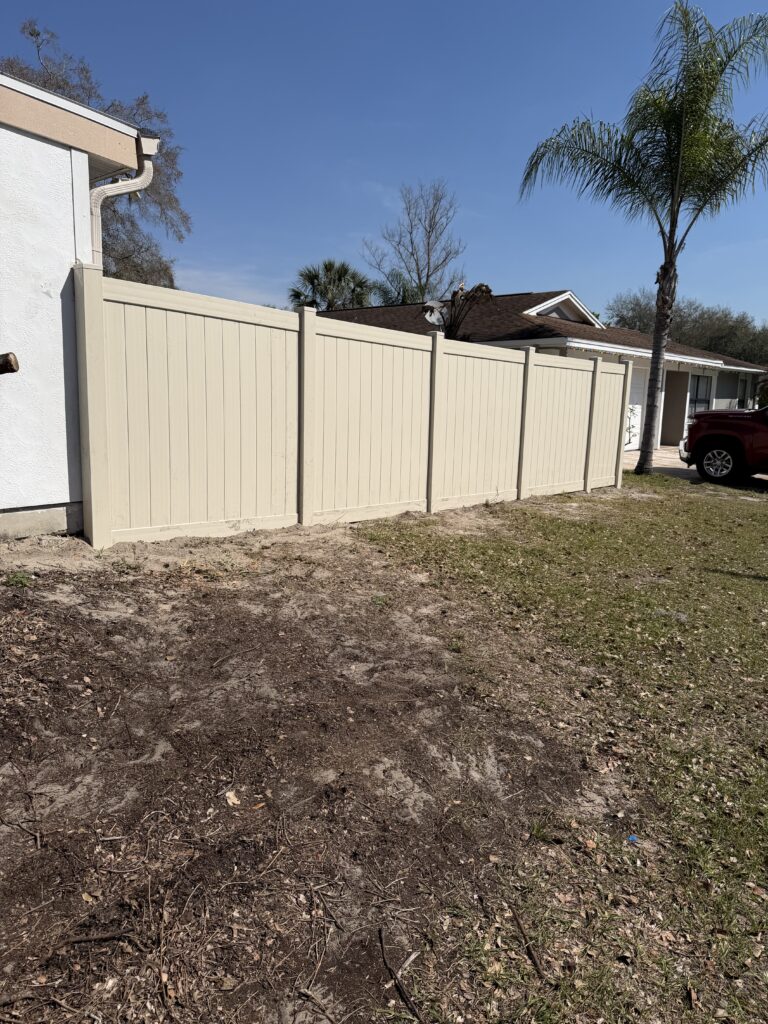
Vinyl is the most common substitute for a tall wood fence in Winter Garden, and for good reason. The panels use tongue and groove pickets that lock together into a solid face, so they block sightlines completely at whatever height you choose, including four and five foot options that feel far less imposing than a six foot wall. Because vinyl does not absorb water, it will not rot at the base the way wood pickets do after a few rainy seasons. It also does not feed termites, and it never needs paint or stain, which matters in a climate where UV exposure breaks down coatings quickly. Quality varies a great deal across the vinyl market; wall thickness, picket count, and rail reinforcement separate a panel that stays flat from one that bows in August heat. Good panels use an aluminum insert in the bottom rail to keep long spans rigid, and they float slightly in the rails to allow for thermal expansion. That expansion is normal and expected, and a proper installation leaves room for it.
Color choice affects how a vinyl fence reads in the yard. White is the traditional pick and reflects heat well, but it shows algae and mildew streaks faster on the shaded north face of a panel. Tan, khaki, and gray tones hide Florida grime better and tend to look more natural against St. Augustine turf and oak canopy. Woodgrain vinyl is also available now, and it gives the warmth of a wood fence without the splitting, cupping, and graying that pine goes through here. If your goal is privacy that does not feel heavy, a five foot vinyl panel in a mid tone color with a lattice or picket accent along the top edge softens the visual mass considerably. You still get a full block at seated and standing eye level, which is where privacy actually matters on a patio. The rest is just aesthetics, and lowering the solid portion by a foot changes the feel of a yard more than most people expect.
Installation quality matters more with vinyl than with almost any other material. Posts carry the entire load, and sandy Central Florida soil offers less lateral resistance than clay, so footings need real depth and real diameter. We generally set privacy posts a minimum of two feet deep, often deeper on taller runs, in a concrete footing wide enough to spread the load. Post spacing should follow the manufacturer’s span rating rather than being stretched to save on materials, since an overspanned rail is the first thing to sag. Gate posts take the hardest use of any post on the property and should be upsized or reinforced with a steel or aluminum core. Solid vinyl panels also catch wind, which is worth taking seriously during hurricane season; correct footing depth, correct post spacing, and correct hardware are what keep a fence standing through a storm band. Ready to install a privacy fence that fits your yard and your soil? Click here for our fence installation service.
Aluminum and Composite Privacy Screens Instead of a Tall Wood Fence
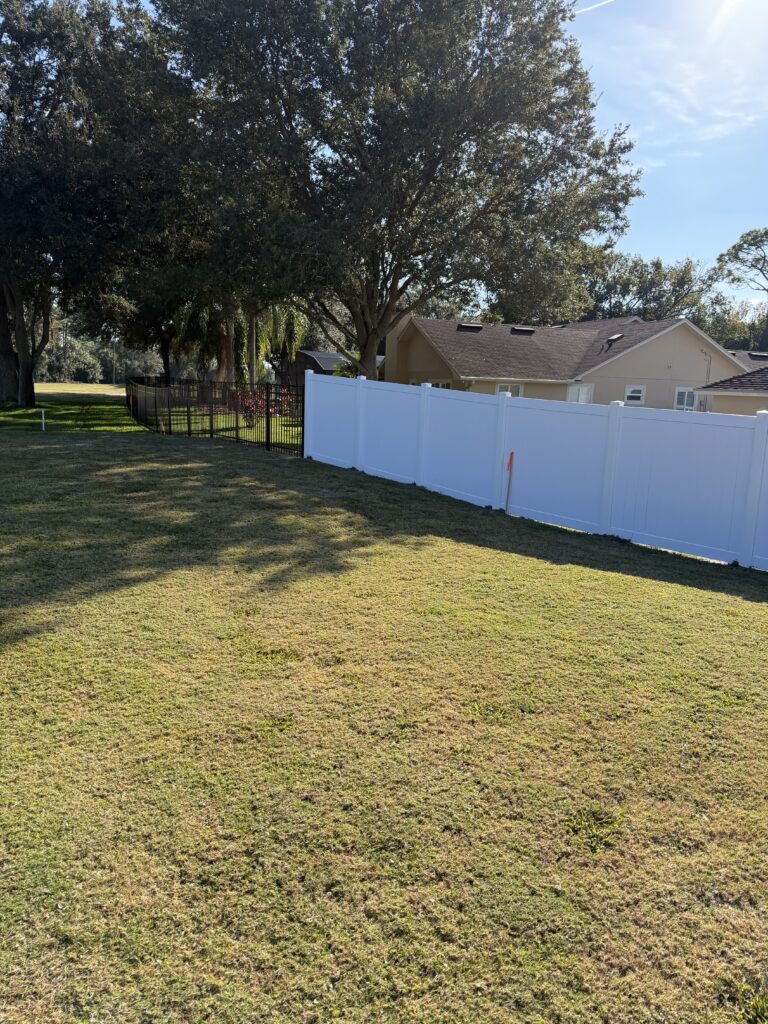
Standard ornamental aluminum fencing does not provide privacy on its own, since the pickets are spaced for visibility and airflow. What it does offer is a clean, low profile boundary that most HOAs approve without argument, especially on lots that back to a pond, conservation area, or retention basin where a view corridor is protected by community rules. Many Winter Garden and Horizon West neighborhoods only allow black aluminum along those rear lines. The workaround is to use aluminum for the property boundary and add privacy closer to the house where you actually need it. Louvered aluminum privacy panels are another option, using angled slats that block direct sightlines while letting air move through. That airflow is a real advantage in a humid climate, because a yard sealed off by solid panels on all sides can feel noticeably stuffier on a still afternoon.
Composite fencing is the other strong contender, and it has come a long way. Composite boards blend wood fiber with polymer, so they resist rot, insects, and moisture absorption while keeping a wood grain texture and a heavier, more substantial feel than vinyl. Horizontal composite designs have become very popular in the newer Winter Garden and Windermere neighborhoods because the lines read as modern and the material holds color well. Composite is heavier than vinyl, so it demands closer post spacing and stouter footings; skimping there is the fastest way to end up with a wavy fence line. Expect some mild color softening in the first year of Florida sun, which is normal for the material and stabilizes afterward. Composite generally costs more upfront than vinyl or wood, and the tradeoff is a fence you clean occasionally rather than one you refinish repeatedly.
Both materials pair well with partial height designs. A four foot aluminum run along an open side yard, stepped up to a five foot composite section behind the patio, gives you privacy exactly where people gather without walling in the entire lot. That kind of mixed approach usually costs less than fencing the whole perimeter at full privacy height, and it photographs better too. It also keeps the yard feeling larger, since a continuous six foot barrier on all sides visually shrinks a space. Drainage is another practical reason to consider slatted or louvered sections; solid panels across a swale can trap water and push runoff toward a neighbor’s lot, which creates problems no fence design should cause. A good installer will look at how water moves across your property before deciding where solid panels belong.
Shadowbox and Lattice Top Designs That Add Privacy Without a Tall Wood Fence
Shadowbox fencing, sometimes called board on board or good neighbor fencing, alternates boards on opposite sides of the rails with a slight overlap. From directly in front you see a solid wall, but air passes through the gaps, which reduces wind pressure during storms and keeps the yard from feeling closed off. It also looks identical from both sides, which prevents the awkward conversation about who gets the finished face. Because the design relies on overlap rather than tight seams, a shadowbox at five feet screens standing eye level views from an adjacent yard quite effectively. It is a design solution rather than a height solution, and that distinction is the whole point of this article. The pattern works in wood, vinyl, and composite, so you are not locked into one material to get the effect.
Lattice top and spindle top designs take a different approach by keeping the solid portion lower and finishing the last twelve to eighteen inches with an open decorative section. The eye reads the fence as taller, the yard reads as more open, and the solid portion still covers the range where privacy matters. This is a strong option in communities with a six foot cap, since you can use the full allowance without ending up with a flat unbroken plane. It also gives climbing plants like confederate jasmine or bougainvillea something to grab, which fills in over a season or two and adds a soft green layer. Just plan for the weight and moisture that mature vines bring, since heavy growth on a lightweight lattice section will eventually pull it apart. Choosing a heavier gauge lattice or a spindle top instead solves that.
Angle and placement can do work that height cannot. Privacy is really a question of sightlines, and a sightline is determined by the position of the viewer, the position of the barrier, and the distance between them. A five foot panel placed eight feet from your patio blocks far more than a six foot fence sitting forty feet away at the back property line. That is why sitting in the actual spot you want to protect, at the actual height you will be sitting, is the single most useful step in planning any privacy project. Look at where the neighbor’s windows are, where the sidewalk traffic passes, and which direction the street noise comes from. Then build for those specific angles instead of building tall everywhere and hoping it works.
Landscaping and Layout Ideas That Add Privacy Without a Tall Wood Fence
Fencing is only half of the privacy equation in Central Florida, and the plant side of it is genuinely powerful here because our growing season is long. A well chosen hedge fills gaps a fence cannot legally cover, softens hard lines, and adds a second layer of screening that changes with the seasons. Layout choices matter just as much, since where you place a barrier determines how much of it you actually need. There are also rules to respect, and those rules shape what is possible before a single post goes in the ground. This section covers living screens, targeted screening near the house, and the code and HOA considerations that come with any privacy project in our area.
Hedges and Living Screens That Add Privacy Without a Tall Wood Fence
Podocarpus is one of the most reliable privacy hedges for Winter Garden and the surrounding Orange and Lake County communities. It grows in a naturally upright column, takes shearing well, holds a dense wall of foliage, and handles our occasional winter cold snaps without damage. Viburnum odoratissimum is the faster option, capable of adding two to three feet of growth in a good year with regular irrigation, which makes it the choice when you want screening quickly. Clusia guttifera has become popular for its thick rounded leaves and clean look, though it is more sensitive to cold than podocarpus and can take damage in a hard freeze this far north. Areca palm creates a tropical clumping screen and works well in protected spots near a lanai. If you want bamboo, insist on a clumping variety in the Bambusa family, never a running type, because running bamboo will travel under a fence and into a neighbor’s yard where it becomes an expensive problem for everyone involved.
Spacing and planting technique determine how fast a living screen closes in. Most privacy hedges go in at three to four feet on center, and planting tighter than that does not speed things up nearly as much as people hope; it just crowds roots and increases disease pressure. In sandy Florida soil, set the root ball slightly above finished grade so water drains away from the trunk, then mulch two to three inches deep while keeping the mulch pulled back from the stems. Irrigation for the first several months is what makes or breaks the planting, since new roots have very little reach and our sand dries fast between rains. Early fall is one of the best planting windows in Central Florida because roots establish through the mild months before spring heat arrives. Plan on light shearing once growth begins so the hedge thickens from the bottom up rather than getting leggy and thin at the base.
The strongest privacy solutions usually combine a fence and a hedge rather than choosing one. A four or five foot fence handles pets, kids, pool code, and the immediate ground level barrier, while the hedge planted just inside it grows past the fence line and screens the upper sightlines a fence legally cannot reach. This layered approach also solves the second story problem, since a neighboring two story home looks down over any fence but is blocked effectively by mature foliage. Leave about eighteen to twenty four inches between the fence and the plants so both stay accessible for maintenance and air circulates behind the hedge. That gap also protects the fence, because plants pressed directly against a panel trap moisture and speed up mildew and staining. If your current fence is failing and you are already rethinking the layout, that is the ideal moment to redesign the whole line. Have an old fence that no longer gives you the privacy you want? Click here for our fence replacement service.

Targeted Patio Screening That Adds Privacy Without a Tall Wood Fence
Most homeowners do not need the entire perimeter of their lot screened; they need one patio, one hot tub, one window, or one seating area protected from view. Building only for those spots costs dramatically less than fencing the whole property at privacy height, and the result usually looks more intentional. A freestanding privacy panel set eight or ten feet off the back of the house can block a neighbor’s kitchen window view completely while leaving the rest of the yard open and bright. Panels like these can be built in vinyl, composite, aluminum louver, or a framed wood section, and they can be set at an angle rather than parallel to the property line to catch a specific sightline. Because they are short runs, they can also be taller in some cases than a boundary fence, though local rules on accessory structures still apply. It is a precise solution to a precise problem.
Pergolas, lanai extensions, and pool cage screening work the same way by putting the barrier close to the person instead of far away at the property edge. Adding a slatted side wall to a pergola creates an outdoor room that feels enclosed without sealing off the yard. Outdoor curtains, shade sails, and roll down screens are the low commitment version of this, and they are easy to retract when you want the space open again. These lighter options come with a real caveat in Florida: anything fabric needs to come down before a storm, and mounting hardware needs to be rated for the load it will actually see in a gust. Permanent slat panels avoid that seasonal chore entirely. Many homeowners end up doing both, using fixed panels where the sightline never changes and retractable screening where it varies with the sun.
Think about sound and light along with sightlines. A solid panel near a seating area reflects and blocks road noise better than a distant fence does, and it also blocks headlight glare from a driveway or side street at night. Fence height near a pool must comply with barrier requirements, and any gate in a pool barrier needs self closing and self latching hardware with the latch positioned per code. Landscape lighting placement changes at the same time, since a new panel creates shadows and can leave a walkway darker than it was. It is worth mapping all of this at the design stage rather than discovering it after the concrete cures. A short site visit usually reveals two or three placement adjustments that improve the result without adding cost.
Grade, Spacing, and HOA Rules When You Add Privacy Without a Tall Wood Fence
Almost every planned community in Winter Garden, Horizon West, Windermere, and Ocoee has architectural review rules governing fences, and those rules typically address height, material, color, and placement. Many communities cap residential fence height at six feet in rear and side yards and four feet in front yard areas, and some restrict rear lines facing ponds or conservation to black aluminum only. Corner lots carry additional visibility requirements so that a fence does not block sight lines at an intersection. HOA approval and a municipal or county permit are separate processes, and getting one does not substitute for the other. Submitting a clear site plan with dimensions, materials, and setbacks up front prevents the delays that come from a rejected application. It is far cheaper to adjust a drawing than to move a finished fence.
Easements and drainage are where privacy projects most often go sideways. Utility easements, drainage easements, and rear access easements can run along the exact line where you want a solid fence, and building over one can mean removal at your expense later. Retention swales need to keep moving water, so a solid panel dropped across a swale without proper clearance at the bottom will dam runoff and shift it onto a neighbor’s property. Sloped and stepped lots require a decision between racking the fence to follow grade or stepping panels down in increments, and each approach creates a different gap profile at the ground. Those gaps matter if you have a small dog or want a full visual seal. Always call Sunshine 811 before any digging so utility lines are marked; it is free, it is required in Florida, and hitting a line is both dangerous and expensive.
Property line accuracy deserves its own mention. Assuming a line based on a neighbor’s old fence, a sprinkler head, or a mowing pattern is a common and costly mistake, and the fix usually involves pulling posts that were set in concrete. A current survey removes that risk and gives you a document to reference if a question comes up later. Setting the fence a few inches inside your own line is a common practice that keeps maintenance access on your side and avoids disputes. If you share the cost of a line fence with a neighbor, get the agreement in writing including who handles future repairs. These conversations are much easier before installation than after. Handling them properly is part of what separates a professional installation from a weekend project that creates problems for years.
Why You Need a Fence Contractor to Add Privacy Without a Tall Wood Fence
Getting privacy without a tall wood fence takes more planning than simply picking a height and a material. It involves reading sightlines, matching materials to Florida conditions, navigating HOA and permit requirements, and building footings that hold up when storm winds arrive. A contractor who works in these neighborhoods every week already knows which communities allow what, how the soil behaves on a given street, and where the drainage runs. That knowledge saves time, prevents rework, and produces a fence that looks right and stays right. Fence Pros builds residential and commercial fencing throughout Winter Garden and the surrounding area, and we handle the design questions alongside the installation.
What a Privacy Fence Estimate Covers When You Skip the Tall Wood Fence
Our estimates are free, and they start with walking the property rather than quoting from a satellite image. We look at where you actually sit and stand, which views bother you, where the neighboring windows sit, and how the ground slopes across the run. From there we talk through material options, realistic heights given your community rules, and where solid panels genuinely earn their cost versus where an open style works better. You get a clear scope with materials, heights, post spacing, gate locations, and hardware spelled out. There are no vague line items and no surprises after the crew arrives.
Pricing depends on linear footage, material, height, gate count, terrain, and access, and we explain how each factor moves the number. Sometimes the most useful thing we do on an estimate is show a homeowner how to spend less by fencing smarter, using privacy panels only where they matter and an open style elsewhere. Other times the honest answer is that the full run needs solid panels, and we say that too. We also flag anything that will require HOA submission or a permit so the timeline is realistic from day one. Knowing the process ahead of time keeps the project moving.
We build for Florida conditions specifically, which means footing depth appropriate for sandy soil, post spacing rated for the panel system, and hardware chosen to resist corrosion in our humidity. Solid privacy panels carry real wind load, and the difference between a fence that survives a storm and one that does not usually comes down to what is underground. That work is invisible once the job is finished, which is exactly why it gets cut by low bidders. We do not cut it. A fence that stands for fifteen years costs less per year than one replaced after five.
Installation and Repair Support After You Add Privacy Without a Tall Wood Fence
Installation day goes smoothly when the prep work is already done, so we confirm utility marking, verify layout against your survey, and review the plan with you before anything is set. Post holes go in first, footings cure, and panels follow, with gates hung and adjusted last so they swing and latch correctly. We keep the site clean as we go and haul away old material and spoil rather than leaving piles behind. You will know who is coming and when, and someone will walk the finished line with you at the end.
Fences take wear here from storms, falling limbs, mower contact, and simple age, and a damaged section rarely means the whole fence needs replacing. Repairs like resetting a leaning post, replacing a cracked panel, rehanging a sagging gate, or swapping corroded hardware restore both function and appearance at a fraction of replacement cost. Catching a small problem early also keeps it from spreading down the run, since one loose post puts extra load on its neighbors. We handle repairs on the systems we install and on fences built by others. Storm season damage in particular is worth addressing quickly before the next round of weather. Need a section fixed before the next storm rolls through? Click here for our fence repair service.
Maintenance for vinyl, aluminum, and composite is refreshingly simple compared to wood. A rinse with a hose and an occasional wash with mild soap handles the algae and pollen film that Central Florida deposits on everything. Check gate hardware once or twice a year and tighten what has loosened, since gates take the most cycles of any part of the fence. Keep hedges and vines trimmed back from panels so moisture is not trapped against the surface. That is genuinely the whole routine for most privacy systems we install.
Why Choose Fence Pros to Add Privacy Without a Tall Wood Fence
Fence Pros is based at 700 Tangelo Ct in Winter Garden, and we serve homeowners and businesses within about an hour of our shop, including Windermere, Horizon West, Ocoee, Apopka, Clermont, Kissimmee, Dr. Phillips, Oakland, Minneola, Davenport, Four Corners, Altamonte Springs, and Casselberry. Working these communities daily means we know the local architectural standards, the permit process, and how the soil and drainage behave from one development to the next. We offer free estimates on all fence projects, residential and commercial. Our materials are selected for Florida weather rather than pulled from a generic national catalog. That local focus shows up in the finished product.
Our work is built around clean lines, strong footings, and results that hold up over time rather than looking good only on the day of install. We show up when we say we will, we communicate clearly about scheduling and any change that comes up, and we leave the property clean. Consistent five star service is the standard we hold ourselves to on every job, from a single gate repair to a full perimeter installation. Straight answers are part of that, including telling you when a smaller scope will get you the privacy you actually want. We would rather build the right fence than the biggest one.
If you want more privacy in your yard and you do not want a tall wood fence to get it, we can walk the property and show you the options that fit your lot, your community rules, and your budget. Early fall is an excellent time to start, with milder weather ahead for enjoying the space and a good planting window for any hedge you want to layer in. Reach us at (407) 580-8353 or email info@fenceprosorlando.com to schedule your free estimate. We will bring material samples, take measurements, and give you a clear written scope with no pressure attached. One conversation is usually all it takes to see how much privacy is possible without building a wall.