
The Best Fence Styles For Spanish And Mediterranean Homes
Spanish and Mediterranean homes carry a strong visual identity, and the fence around the property either supports that identity or fights it. Central Florida has thousands of these homes in Winter Garden, Windermere, Dr Phillips, and Horizon West, most of them finished with stucco walls, barrel tile roofs, arched entries, and warm earth tone paint. The right fence borrows from those same details instead of introducing a look that belongs on a completely different house. Late summer is a practical time to plan the project, since the rainy season is winding toward the drier fall months and crews can set posts before the ground turns hard and dusty. Material choice matters as much as style here, because humidity, sandy soil, and heavy afternoon storms punish the wrong products very quickly. This guide covers the fence styles that suit Spanish and Mediterranean architecture, the materials that survive Florida weather, and the code details that decide what you can actually build on your lot.
The Best Fence Styles For Spanish And Mediterranean Homes In Central Florida
Spanish and Mediterranean architecture is built on a small set of repeating details, and a fence that echoes even two or three of them will look intentional rather than added on later. Those details include textured stucco surfaces, clay tile accents, arched openings, dark iron hardware, and colors pulled from sand, clay, and terracotta. Three fence styles handle this better than anything else on the market: stucco finished masonry walls, ornamental aluminum panels that imitate traditional wrought iron, and wood fencing paired with heavy black hardware and an arched gate. Each one carries a different price point, a different maintenance schedule, and a different level of privacy, so the best choice depends on your lot, your budget, and your neighborhood rules. Many homeowners in the Winter Garden area combine two of them, using a solid wall along the street and open aluminum along the sides where they want light and airflow. The sections below break down how each style performs on a real Florida property.
Stucco Wall Fence Styles That Match Spanish And Mediterranean Homes
A stucco finished masonry wall is the most authentic option available for Spanish and Mediterranean homes, because it uses the same surface treatment as the house itself. The wall is built from concrete block set on a poured footing, with vertical rebar running through grouted cells to tie the wall to that footing. Once the block is up, the mason applies stucco in coats over lath or directly over the block, then finishes it with a texture chosen to match the existing house. Common finishes in Central Florida include sand, lace, and smooth trowel, and matching the existing texture is what makes the wall read as part of the original build. Color comes from paint or from integrally colored finish coat, and most homeowners pull the shade directly from the body color of the house. A cap finishes the top, usually a row of clay barrel tile set in mortar or a precast concrete cap that sheds water away from the wall face.
Cost is the honest tradeoff with masonry, since a stucco wall runs several times the price of a wood or aluminum fence of the same length. Permits are almost always required, and walls above a certain height frequently need an engineered footing detail before the county will approve the plans. The footing has to be sized for the soil on your lot, and Central Florida sand behaves differently than the clay soils that masons work with in other states. Skipping the engineering step is how walls end up with stair step cracks running through the stucco two or three years after they are built. Drainage also has to be planned into the design, because a solid wall crossing a swale will dam water during a summer storm and push it toward a neighbor. Weep openings or a break in the wall at the low point solve this cleanly when they are planned before the block goes up.
Maintenance on a stucco wall is light but not zero, and the work is mostly cosmetic. Hairline cracks show up as the wall goes through years of heating and cooling, and they are sealed with a flexible patch material and touched up with paint. Pressure washing once a year removes the mildew and algae that Florida humidity grows on any shaded north facing surface. Sprinkler heads should be aimed away from the base of the wall, since constant water against the stucco causes staining and eventually breaks down the finish coat. Landscaping planted tight against the wall traps moisture in the same way, so leaving a few inches of clearance pays off over time. Handled that way, a stucco wall built on a proper footing will outlast every other fence style on the property by decades.

Ornamental Aluminum Fence Styles For Spanish And Mediterranean Homes
Ornamental aluminum is the practical replacement for traditional wrought iron, and it is the single most popular choice for Mediterranean homes across the Orlando area. Real wrought iron and mild steel both rust in Florida humidity, and once rust starts inside a hollow picket it works from the inside out where no amount of paint will reach it. Aluminum does not rust at all, and the powder coated finish applied at the factory holds its color under constant sun far better than a brush applied paint. Panels come in flat top, spear top, and arched top profiles, and the spear top styles with a horizontal top rail carry the classic look that suits Spanish architecture. Scroll work, rings, and finials are available as add ons for homeowners who want a more decorative front entry gate. Standard residential panels come in six foot widths with heights from four to six feet, and rackable panels follow a sloped yard without leaving gaps at the bottom.
Aluminum also solves a problem that solid fencing creates on Florida lots, which is airflow. Open pickets let breeze pass through a courtyard instead of trapping heat against the house, and they keep sight lines open toward a pool, a pond, or conservation land behind the property. That same openness makes aluminum the standard choice for pool enclosures, and Florida code is specific about how a pool barrier must be built. A residential pool barrier must reach a minimum height, gates must swing away from the water, and every gate needs a self closing hinge with a self latching latch mounted high enough that a small child cannot reach it. Picket spacing has to be tight enough that a four inch sphere cannot pass through, and the gap under the fence is limited as well. A contractor who installs these regularly will size the panels and set the latch height so the inspection passes on the first visit.
Color selection is where aluminum either matches the house or misses it. Matte black is the safe default and pairs with the dark iron window grilles and light fixtures found on most Spanish homes. Bronze and dark brown work well on homes with heavy wood accents, arched wood doors, or exposed rafter tails under the eaves. Posts should be sized correctly for the panel height, with larger posts used on gate openings that carry the weight of a swinging leaf. Setting posts in concrete rather than tamped soil is what keeps the line straight, since sandy soil offers very little lateral support on its own. Done properly, an aluminum fence needs nothing more than an occasional rinse and a check of the gate hardware once or twice a year. Ready to price out a new fence for your property? Click here for our fence installation service.
Wood Fence Styles That Suit Spanish And Mediterranean Homes
Wood is the budget friendly path to a Mediterranean look, and it works when the details are chosen carefully. A standard board on board or shadowbox fence in natural cedar or cypress reads warm against a tan or cream stucco house, especially once it is stained rather than left to gray. The style upgrade that matters most is the gate, since an arched top gate with heavy black strap hinges and a ring pull latch instantly connects the fence to the arched openings on the house. Horizontal board fencing has become common in newer Winter Garden neighborhoods and pairs well with the cleaner Mediterranean revival homes built in the last fifteen years. Adding stucco finished columns at the corners and at gate openings gives a wood fence the masonry framing of a courtyard wall at a fraction of the cost. That column and panel combination is one of the best value designs available for these homes.
Florida is hard on wood, and material grade decides how long the fence lasts. Posts must be pressure treated lumber rated for ground contact, since standard above ground treated lumber will fail below the soil line in a few short years. Termites are active year round in Central Florida, and untreated pine in contact with soil is an open invitation. Posts belong in augered holes set in concrete, with the concrete crowned above grade so water runs away from the post instead of pooling around it. Rails and pickets can be cedar or cypress for appearance, though both cost more than treated pine and both still need a sealer. Fastener choice matters too, because standard fasteners corrode against treated lumber and leave black streaks running down the boards within a season.
Ongoing care is the real cost of wood, and it should factor into your decision before the first board goes up. A quality stain with UV blockers should be reapplied every two to three years in this climate, since our sun fades finishes faster than it does in northern states. Between coats, a light wash removes mildew from the shaded side of the fence, which is usually the side facing the house. Sprinkler spray hitting the pickets daily will destroy a wood fence faster than anything else, so heads should be adjusted after the fence is installed. Boards will cup or split individually over time, and swapping a few pickets each year keeps the run looking sharp. Homeowners who follow that routine regularly get fifteen years or more out of a wood fence, and those who skip it start looking at replacement around year eight.
How To Choose Fence Materials For Spanish And Mediterranean Homes In Florida
Style gets the attention, but material performance decides how the fence looks five years from now. Central Florida combines high humidity, intense UV exposure, sandy soil with poor lateral support, and summer storms carrying strong wind gusts, and each of those factors rules out certain products. Color and finish selection sits right next to material choice, because the wrong shade of tan will clash with a stucco house that has three warm tones already working together. On top of that, permits, setbacks, and neighborhood approvals set hard limits on height, placement, and sometimes even material. Homeowners who sort out these three items before ordering material avoid the two most common problems, which are a fence that fails early and a fence that has to be moved after an inspection. The sections below cover each one in order.
Fence Materials For Spanish And Mediterranean Homes That Handle Florida Humidity
Humidity is the deciding factor for metal fencing, and it is the reason powder coated aluminum has replaced iron on nearly every new installation in the region. Aluminum will not rust under any level of moisture, and the powder coating is baked onto the metal rather than brushed on, which gives it a much tougher surface than field applied paint. Steel fencing is available with galvanized coatings and does outperform bare iron, though any scratch that reaches base metal will begin to corrode in our climate. If you already have an iron fence and like it, the fix is to keep the coating intact and address rust spots the moment they appear rather than waiting. For homeowners near lakes or retention ponds, where morning moisture sits longer, aluminum is the clear choice. The maintenance difference over ten years is dramatic and shows up directly in your repair costs.
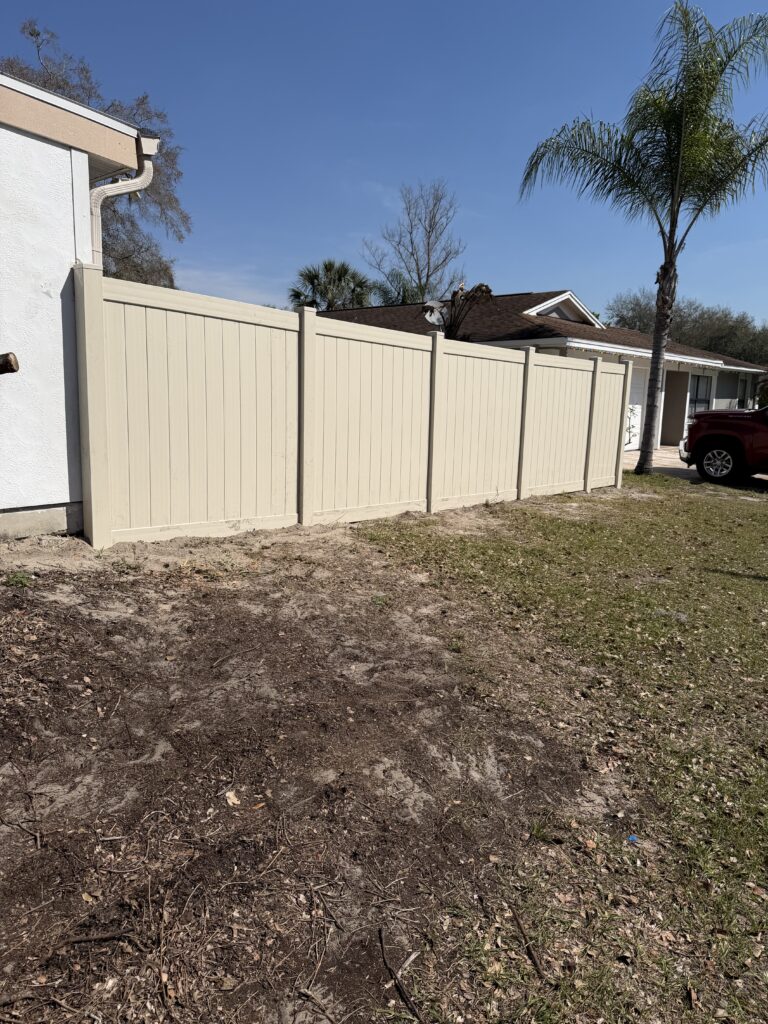
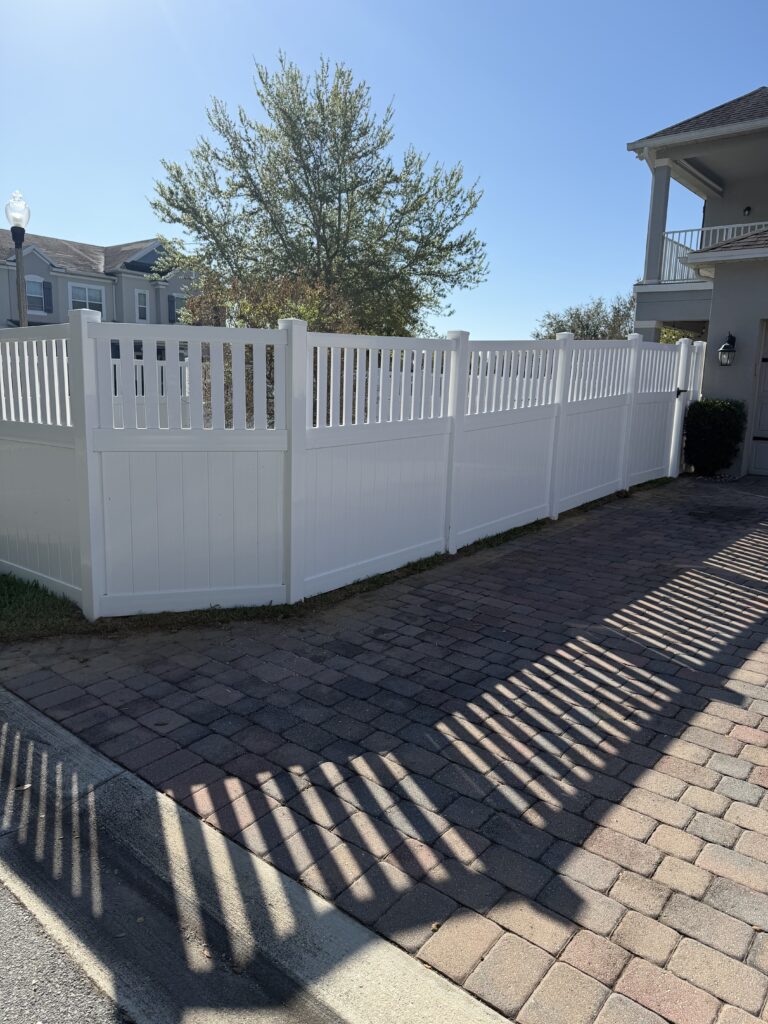
Vinyl deserves a mention because it appears in many Central Florida communities, and modern vinyl comes in tan, almond, and khaki tones that suit Mediterranean color schemes. Quality matters more with vinyl than with any other fence material, since thin extrusions with weak UV packages chalk, yellow, and grow brittle after a few Florida summers. Better vinyl uses titanium dioxide in the formulation to resist UV breakdown and carries a thicker wall on both posts and rails. Reinforced posts and properly seated rails are what keep a vinyl privacy fence standing through a storm, because wind load on a solid panel is significant. The material never needs paint, and cleaning is a hose and a soft brush. The limitation is appearance, since vinyl will never carry the texture and weight of stucco or the detail of ornamental metal.
Soil conditions matter as much as the material above ground, and Central Florida sand is unforgiving of shallow post work. Sand drains fast but provides very little side resistance, so a post that is not embedded deep enough in a concrete collar will begin to lean under normal wind load. Depth should be scaled to fence height, with taller privacy fences requiring deeper and wider footings than a four foot pool fence. Gate posts carry the most stress on any fence and should always be set deeper and heavier than line posts, since a sagging gate is the most common repair call we receive. Water table depth varies across the region and can affect how a hole is prepared during the wet season. An experienced crew adjusts the footing on site rather than digging every hole to the same depth. Already have a fence showing rust, leaning posts, or a dragging gate? Click here for our fence repair service.
Fence Colors And Finishes For Spanish And Mediterranean Homes
Color coordination is where a fence project either finishes clean or looks slightly wrong in a way nobody can name. Spanish and Mediterranean homes typically use a light stucco body in cream, sand, ivory, or terracotta, with a red or orange barrel tile roof and dark accents at the windows, doors, and light fixtures. The safest approach is to pull the fence color from the accent palette rather than the body color, which is why black and dark bronze aluminum works so reliably. When the fence is a stucco wall, the opposite rule applies, and the wall should match the body color of the house as closely as possible so it reads as an extension of the architecture. Matching stucco color requires matching both paint and texture, since the same color over a different texture will still look like a patch. Bringing a sample or a paint code to the estimate makes this step easy.
Finish type carries the same weight as color. Powder coating on aluminum comes in gloss, satin, and matte, and matte or satin black looks far more like traditional ironwork than a high gloss finish does. On wood, a semi transparent stain in a warm brown or cedar tone lets the grain show while adding the UV protection the wood needs. Solid stains and paints hide the grain but last longer between coats, which some homeowners prefer for a low attention fence. Hardware should be selected in the same finish family as the exterior fixtures on the house, since mismatched hinges and latches pull the eye immediately. Black hardware is the default on these homes and pairs correctly with almost every color scheme.
Accent details tie the whole design together and cost very little compared to the fence itself. A row of clay barrel tile capping a stucco wall is the strongest single detail available and repeats the roofline right at eye level. Decorative tile inlays set into wall columns bring in the blues and greens common to Mediterranean design without overwhelming the palette. Wall mounted lanterns on gate columns extend the lighting style of the front entry out to the property line and add real security value. Arched openings, even a simple arch cut into the top of a wood gate, are the fastest way to connect a fence to Spanish architecture. Small choices like these separate a fence that merely encloses the yard from one that finishes the house.
Permits And HOA Rules For Fences On Spanish And Mediterranean Homes
Permitting is a required step for most fence projects in Orange, Lake, Osceola, and Seminole counties, and masonry walls face more review than any other type. The permit application typically requires a survey showing the fence location, the proposed height, the material, and the setback from property lines. Front yard fences are commonly limited to a lower height than side and rear fences, and corner lots have additional restrictions where the fence approaches an intersection. Those corner restrictions exist to preserve driver sight lines and are enforced strictly, so a solid wall cannot simply run to the corner of the lot. Masonry walls above a set height usually need an engineered footing detail submitted with the application. Pool barrier fences are inspected against specific safety requirements covering height, picket spacing, gate swing, and latch position.
Neighborhood rules add a second layer on top of county code, and in the Winter Garden and Horizon West area they are often stricter than the county itself. Many communities publish an approved material and color list, and some prohibit certain styles outright along street facing property lines. Approval usually requires a written application with a site plan, a material description, and a color sample, and the review board may meet only once or twice a month. Starting that submission early prevents a delay that pushes the project past the timeline you had in mind. Building without approval can result in a demand to remove or modify the fence entirely, which is an expensive lesson. Reviewing your covenants before you select a style saves a great deal of frustration.
Property line accuracy is the last piece and the one homeowners most often get wrong. A recent survey is the only reliable way to know where your line sits, since existing fences, hedges, and irrigation lines frequently sit inside or outside the true boundary. Building over a line creates a legal problem with your neighbor and may require moving the entire run at your expense. Utility locates are also required before any digging, and the free statewide locate service marks buried lines before a crew arrives. Irrigation lines and low voltage lighting are not covered by that service, so those should be identified separately by the homeowner. A contractor who walks the property, checks the survey, and calls in locates before scheduling is protecting you as much as themselves.
Why You Need The Right Fence Contractor For Spanish And Mediterranean Homes
The design decisions covered above only work if the installation is done correctly, and fencing is a trade where shortcuts stay hidden until the first strong storm. Post depth, footing width, gate post sizing, and hardware selection are all invisible once the job is complete, but they determine how the fence performs for the next fifteen years. Matching stucco texture, setting a tile cap in mortar, and hanging a heavy arched gate so it swings true all require experience with these specific home styles. Central Florida also brings its own conditions in sandy soil, high humidity, summer storm loads, and county permitting that out of area methods do not account for. A contractor who works in this market every week already knows what passes inspection and what fails. That knowledge is what turns a good design into a fence that holds up.
Planning A Fence Installation For Spanish And Mediterranean Homes
A solid installation starts with a site visit rather than a phone quote, because every Mediterranean home sits on a lot with its own grade, drainage, and landscaping. During that visit the layout gets walked, the gate locations get placed where they actually make sense for mowers and trash cans, and the slope gets measured to decide between racked and stepped panels. Existing features like pool decks, AC pads, and irrigation lines get noted so the fence line does not conflict with them. This is also when material samples and color options should be reviewed against the house in daylight. Getting these details settled up front is what keeps the install itself quick and clean.
The build sequence follows a predictable order once the permit and locates are in hand. Post holes are augered, posts are set in concrete and braced plumb, and the concrete is given time to cure before any panels or gates are hung. Rushing that cure is the most common cause of a fence line that drifts out of alignment within the first year. Gates go last and get adjusted on site so they close square and latch without lifting. A final walk of the completed line catches anything that needs correction while the crew is still on the property.
Every property has its own quirks, and a good crew adapts instead of forcing a standard layout onto an unusual lot. Conservation easements, retention pond slopes, and drainage swales all show up regularly in Winter Garden and Horizon West neighborhoods. Tree roots complicate post placement and sometimes require shifting a post a foot in either direction rather than cutting through a root that supports a mature oak. Those field decisions are where experience shows, and they get made in the moment by someone who has seen the same situation before. Handling them correctly is what produces a straight, level, long lasting fence.
Repair And Replacement Options For Fences On Spanish And Mediterranean Homes
Not every project starts from scratch, and many homeowners with Spanish and Mediterranean homes are working with a fence that has aged out. Leaning posts, cracked stucco, rusted iron pickets, sagging gates, and storm damage are the issues we see most often across the Orlando area. Some of these are straightforward repairs, and replacing a failed section or resetting a gate post costs far less than a full replacement. Rust on a metal fence should be addressed early, since a scratch left alone becomes a hole in the picket within a couple of seasons. A quick assessment tells you which path makes financial sense.
Full replacement becomes the better choice once repair costs start approaching a meaningful share of a new fence. Wood fences with widespread rot at the base of multiple posts fall into this category, since resetting post after post costs more in labor than starting fresh. Old iron fences with rust running through the base of the pickets are a similar situation, and replacing them with powder coated aluminum ends the problem permanently. Replacement is also the moment to upgrade the style, and many homeowners take the opportunity to move from plain chain link to something that actually matches the house.
Storm season adds urgency to any of this, and Central Florida runs an active hurricane season through the fall. A fence with weak posts or loose panels is the first thing to fail in a strong wind event, and loose panels become debris that damages the house and the pool cage. Addressing weak sections before a storm is far cheaper than the cleanup after one. Insurance claims for fence damage also move faster when the fence was in sound condition beforehand. Getting an assessment now, ahead of the peak of the season, is the smart move. Fence past the point of repair? Click here for our fence replacement service.
Why Choose Fence Pros For Spanish And Mediterranean Home Fence Styles
Fence Pros works in Winter Garden and the surrounding communities every week, and we know these neighborhoods and the homes in them. We build stucco walls, ornamental aluminum, vinyl, and wood, which means our recommendation is based on your house and your budget rather than the one product we happen to sell. Estimates are free on all fence projects, residential and commercial alike, and we walk the property before quoting so the number you receive is a real number. We select materials rated for Florida conditions because we are the ones who get called back when the wrong material fails.
Our crews handle permits, locates, and inspections as part of the job, and we build to the height, setback, and pool barrier requirements enforced in our service area. Clean work matters to us, which means straight lines, plumb posts, square gates, and a property left the way we found it. We serve Winter Garden, Windermere, Dr Phillips, Horizon West, Ocoee, Apopka, Clermont, Kissimmee, and communities within about an hour of our shop. Consistent five star service is the standard we hold ourselves to on every project, from a single gate repair to a full courtyard wall.
If you are ready to give your Spanish or Mediterranean home a fence that actually fits the architecture, we are ready to help you plan it. Call Fence Pros at (407) 580-8353 or email info@fenceprosorlando.com to schedule your free estimate. Our office is located at 700 Tangelo Ct, Winter Garden, FL 34787, and we cover residential and commercial fencing throughout the greater Orlando area. Reach out today and we will get your project scheduled while the fall installation calendar is still open.